


The automotive appearance and protection industry is entering one of its most important growth periods yet. In 2026, window tint and paint protection film (PPF) are no longer niche upgrades reserved for exotic vehicles. They are increasingly viewed as essential services for protecting vehicle investments, improving comfort, preserving resale value, and creating additional dealership revenue.
For dealership owners and automotive professionals, this creates a clear opportunity: build an in-house team of properly trained, certified installers before the labor shortage becomes an even greater operational constraint.
The demand is growing across Canada and the USA. However, demand alone does not create profit. Dealerships need technicians who can produce consistent, production-ready work at volume. That is why certified professionals with hands-on training are becoming more valuable than ever.
The 2026 market is being driven by protection, technology, and premiumization
Tint and PPF demand is being accelerated by several converging trends:
- Higher vehicle prices and increased concern about protecting automotive investments
- Growing EV adoption and the need to preserve expensive paint and large glass areas
- Increased consumer awareness through social media and automotive culture
- Better film technology, including ceramic tint and self-healing PPF
- Dealership interest in bringing profitable accessory services in-house
- A shortage of installers who can meet professional quality standards
Tint Academy’s 2026 Industry Report on window tinting and PPF identifies continued growth in both markets, with training and certification becoming central to the industry’s next phase.
The opportunity is especially significant for dealerships. When tint and PPF are outsourced, the dealership loses control over scheduling, quality, customer experience, and a portion of the gross profit. An in-house team can complete work faster, standardize the process, and retain more revenue per vehicle.
Trend #1: Ceramic window tint is becoming the expected premium option
Basic dyed tint is no longer the only product customers ask about. Modern buyers are increasingly interested in ceramic and nano-ceramic films because of their heat rejection, UV protection, clarity, colour stability, and compatibility with vehicle electronics.
This premiumization is changing the role of the installer. A professional must understand more than how to apply film. They must know how to:
- Recommend the right film for the customer’s goals and budget
- Work around modern vehicle electronics, sensors, cameras, and displays
- Maintain clean edges and consistent shade across the vehicle
- Follow applicable provincial and state tint laws
- Deliver results that support dealership warranties and customer satisfaction
This is why automotive window tinting certification is becoming an important career advantage. Certified professionals are better positioned to work with franchise dealerships, premium brands, fleet operations, and high-volume service departments.
For dealership owners, trained staff also make it easier to sell tint as part of a standardized delivery package rather than treating it as an inconsistent add-on.
Trend #2: PPF demand is expanding with EVs and high-value vehicles
Paint protection film has evolved from a basic “clear bra” into a premium protection and customization service. Self-healing topcoats, improved clarity, anti-yellowing technology, satin finishes, matte finishes, and colour PPF are expanding what dealerships can offer.
EVs are a major driver of this growth. Many EV owners are highly focused on technology, appearance, long-term ownership, and resale value. EVs also commonly feature large glass areas, distinctive paint finishes, and costly body repairs, making protection services particularly relevant.
Research published by Polar Tint indicates that EV owners may attach PPF at significantly higher rates than comparable internal-combustion vehicle owners. Whether the customer is purchasing a new luxury EV, an electric truck, or a high-end performance vehicle, the demand for front-end and full-body protection is increasing.
That creates strong demand for professionals who complete a true paint protection film training program: not simply a short demonstration or online video course.
Trend #3: Dealerships are bringing tint and PPF in-house
Outsourcing can be convenient, but it creates limitations. A third-party installer may have limited availability, inconsistent processes, and no direct accountability to the dealership’s internal standards. Delays can affect vehicle delivery, while re-dos can reduce gross profit and damage customer trust.
More dealerships are responding by investing in internal capability.
An in-house operation can help a dealership:
- Complete installations on its own delivery schedule
- Reduce dependence on subcontractors
- Improve quality control and customer communication
- Build consistent pricing and package structures
- Keep more accessory revenue within the dealership
- Create career paths for existing service employees
- Standardize installation procedures across multiple locations
This is the foundation of Tint Academy’s on-site dealership training. Certified instructors travel directly to the dealership and train staff using real vehicles, real workflows, and the actual conditions of the operation.
That approach is fundamentally different from generic classroom instruction. Dealership teams learn how to work efficiently in a production environment: not just how to complete one perfect vehicle in a controlled training bay.

Trend #4: Standardization is becoming a competitive advantage
In a high-volume dealership, quality cannot depend on individual improvisation. Every technician should follow a repeatable installation process, from vehicle preparation and film selection to final inspection and delivery.
Standardized training helps reduce:
- Contamination and debris
- Uneven edges
- Excessive stretching
- Poor pattern alignment
- Incorrect film selection
- PPF lifting and edge failure
- Customer complaints and warranty issues
- Re-dos that consume technician time
A documented process also makes it easier to train new employees, measure performance, and maintain consistent standards across dealer groups and auto malls.
For owners, this is more than a quality initiative. It is an operational and financial decision. Every re-do represents lost labour capacity, wasted material, delayed delivery, and reputational risk.
A certified team gives management a clear framework for accountability and continuous improvement.
Trend #5: PPF training is becoming a career accelerator
As the installer shortage continues, professionals who can perform both tint and PPF work will have a significant advantage. Window tint remains a strong volume service, while PPF offers higher-ticket opportunities and requires more advanced technical ability.
A qualified installer may progress from technician to:
- Lead installer
- Production supervisor
- Dealership appearance department manager
- PPF department trainer
- Mobile service operator
- Independent shop owner
- Multi-location operations manager
Completing a professional PPF training program can accelerate that progression by giving technicians practical experience with patterns, tools, surface preparation, stretching, positioning, edge management, and quality inspection.
Tint Academy’s certified automotive window tint course provides a foundation for professionals who want to develop real installation skills. For dealerships, the benefit is a trained employee who can contribute immediately instead of spending months learning through expensive trial and error.
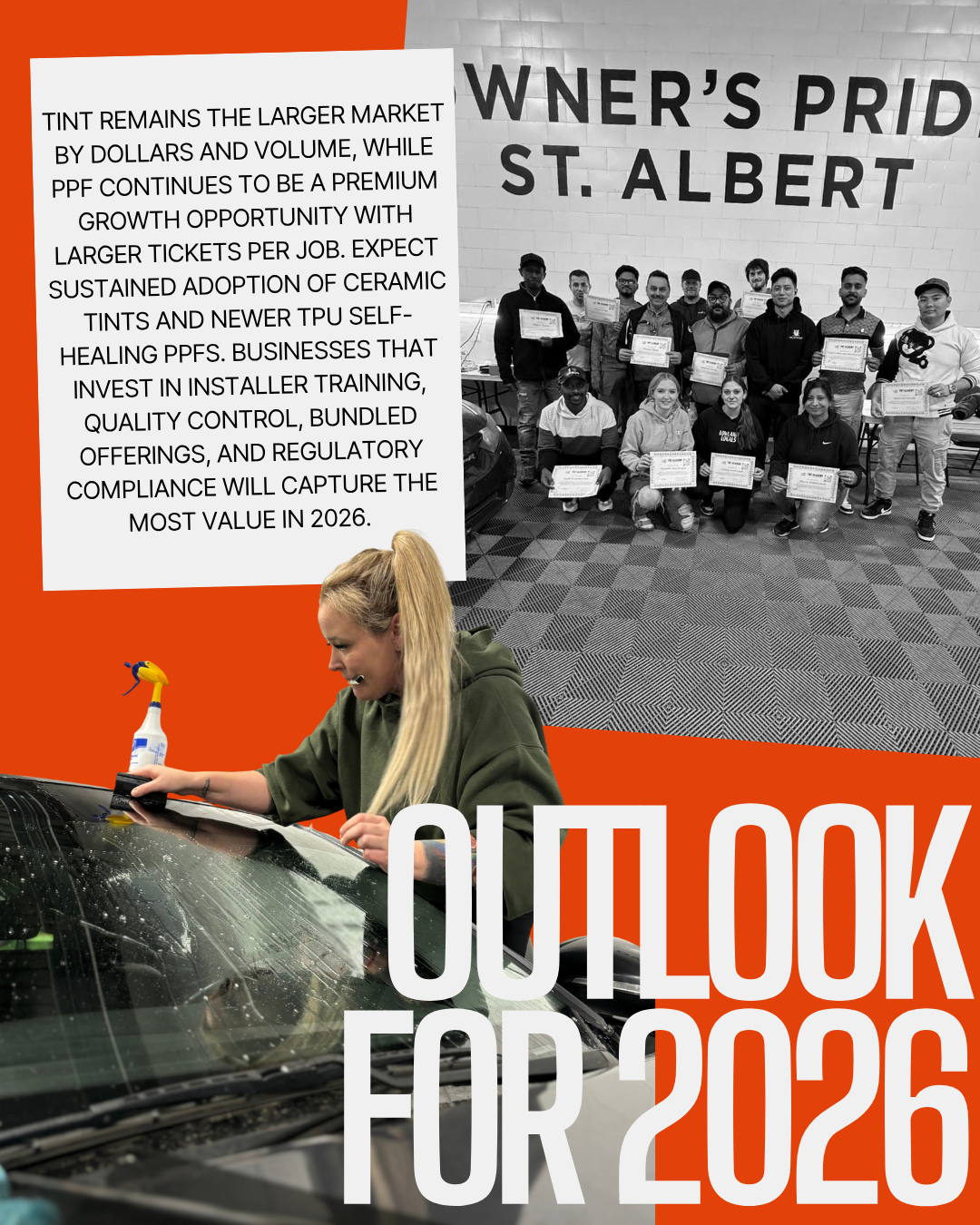
Tint Academy: the gold standard for dealership training
Tint Academy is positioned as the premier window tint and PPF training provider in Canada and the USA because our programs are built around real automotive production: not theory alone.
Our training focuses on:
- Hands-on window tint training
- Paint protection film training
- Production-ready installation techniques
- High-volume dealership workflows
- Quality control and inspection
- Repeatable processes that reduce re-dos
- Practical use of plotters, software, and professional tools
- Business and revenue considerations for dealership operations
Dealership training packages also include a complete Scorpion Films PPF setup at no extra cost. This includes the plotter, software, and tools required to begin building an in-house PPF operation.
That equipment inclusion removes one of the most common barriers dealerships face: completing training but still lacking the tools required to produce work immediately.
The results can be substantial. Many dealerships see monthly revenue increases in the range of $35,000 to $50,000 or more after training, depending on vehicle volume, package pricing, staffing, and execution. This benchmark is not a guarantee, but it demonstrates the revenue potential available when a dealership builds a reliable internal tint and PPF department.
Why certification matters to dealership owners
A certificate alone does not replace skill. However, a serious certification program signals that a professional has been trained in proper techniques, understands production standards, and is committed to continuous improvement.
For dealership owners, certification can support:
- More confident hiring and promotion decisions
- Stronger customer trust
- Better consistency between technicians
- Easier onboarding and staff development
- Improved dealer-group standardization
- More professional marketing and package presentation
- Reduced reliance on a limited pool of subcontractors
The strongest operations will not simply hire anyone who claims to install film. They will develop trained teams and build internal systems around quality, speed, and accountability.
The dealerships that train early will lead in 2026
The installer labor shortage is not expected to disappear quickly. It takes time to develop professionals who can complete clean tint installations and production-quality PPF work consistently. Dealerships that wait until demand overwhelms their current suppliers may face delivery delays, rising outsourcing costs, and missed accessory revenue.
The better strategy is proactive:
- Identify employees with the right technical mindset
- Invest in tint and PPF certification
- Create a dedicated workflow and installation area
- Standardize film, tools, pricing, and quality inspections
- Track revenue, labour hours, re-dos, and customer satisfaction
- Build tint and PPF into the vehicle delivery process
In 2026, certified professionals will not simply be filling jobs. They will be helping dealerships create new profit centres and deliver a more complete ownership experience.
Build your dealership’s advantage with Tint Academy
The demand for automotive window tinting and PPF is growing across Canada and the USA. The question is whether your dealership will continue outsourcing that opportunity: or build the expertise to capture it in-house.
Tint Academy delivers hands-on, on-site training designed for dealerships, dealer groups, auto malls, and serious automotive professionals. With production-ready instruction, standardized processes, and a complete Scorpion Films PPF setup included at no extra cost, we help teams move from interest to implementation.
To discuss enrollment or dealership training, call or text 289-201-2070 or email adam@tint.academy.
Take the next step toward tint and PPF certification, stronger quality control, and a more profitable automotive operation with Tint Academy: the industry gold standard for professional film training.

Share and get 15% off!
Simply share this product on one of the following social networks and you will unlock 15% off!