


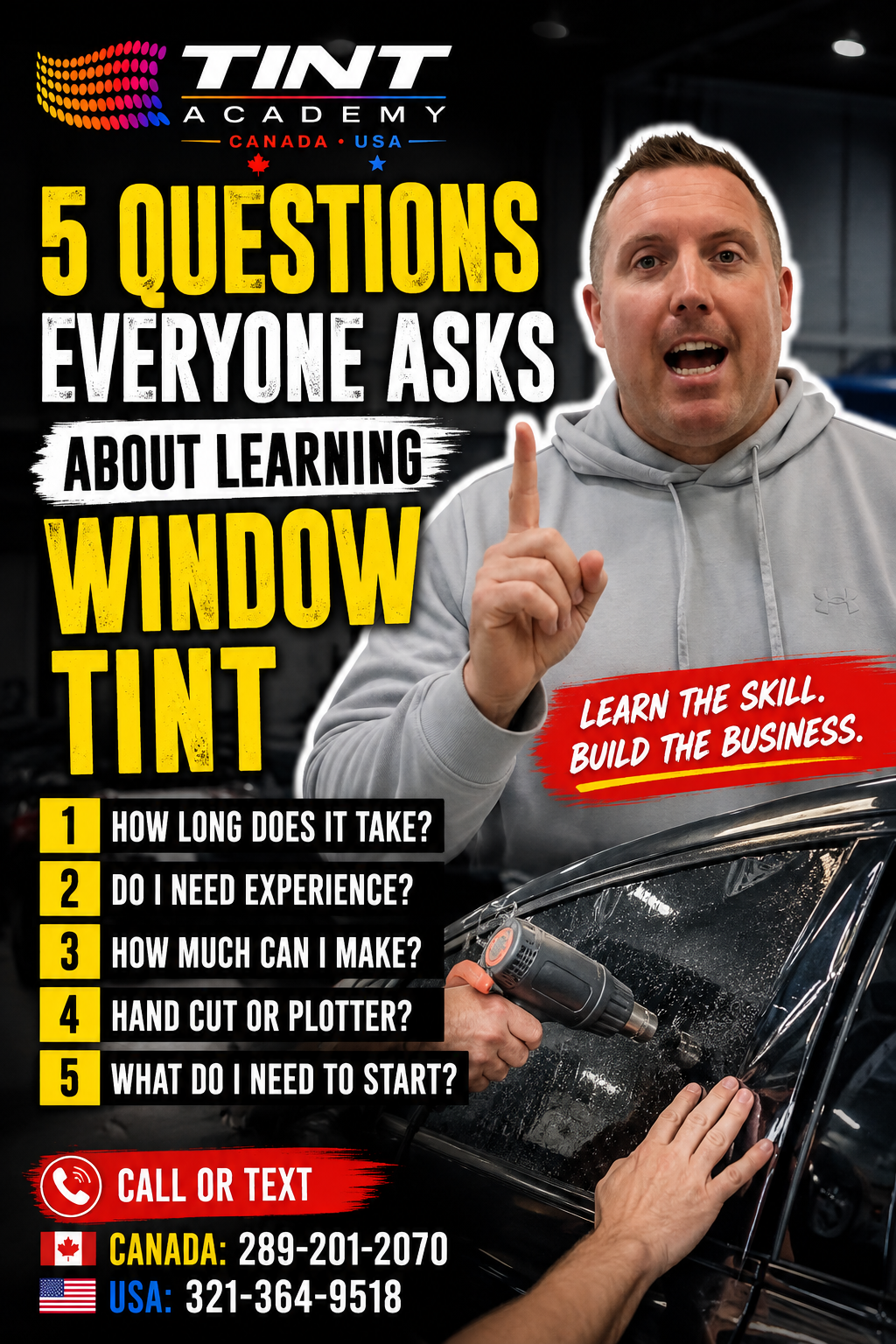
If you’ve ever searched “How do I learn window tinting?”, “Is window tinting hard to learn?” or “Can I make money tinting windows?”, you’re not alone.
At Tint Academy, we speak with beginners, automotive enthusiasts, detailers and entrepreneurs who are interested in learning window film installation but aren’t sure where to start.
While everyone’s situation is different, the same questions come up again and again.
How long does it take? Do I need experience? How much can I make? Should I hand cut or use a plotter? What equipment do I actually need?
So, let’s answer the 5 biggest questions people ask before learning automotive window tinting.
1. How Long Does It Take to Learn Window Tinting?
This is usually the first question.
The important distinction is between learning the fundamentals and mastering the trade.
With focused, hands-on instruction, a beginner can start learning the core window tint installation process in a matter of days.
That includes understanding:
- Proper glass preparation
- Cleaning techniques
- Film handling
- Measuring and cutting window film
- Hand cutting
- Using plotter-cut patterns
- Heat shrinking
- Side-window installation
- Rear-window installation
- Squeegee techniques
- Removing excess solution
- Edge finishing
- Contamination control
- Identifying and correcting installation problems
But completing a course doesn’t mean you’ll instantly install every vehicle perfectly.
Practice Is Where Your Skills Develop
Think about learning window tinting like learning any skilled trade.
Training gives you the correct process and foundation.
Practice gives you speed, consistency and confidence.
Your first installation may take considerably longer than an experienced installer’s. After completing more vehicles, you begin recognizing patterns.
You learn how different windows react to heat.
You become more comfortable handling film.
Your cuts improve.
Your shrinking becomes faster.
Your installations become cleaner.
That’s why we encourage students to continue practicing immediately after completing their training.
Learn the fundamentals correctly first, then build repetition.
2. Do I Need Experience Before Learning Window Tint?
No.
You don’t need to be a mechanic, detailer or experienced automotive technician to begin learning window tint.
Many people attending Tint Academy courses are complete beginners.
They may have never held a tint knife.
They may have never used a heat gun.
They may have never touched window film.
That’s okay.
Why Hands-On Training Matters
There is an enormous amount of free window tint information available online.
YouTube and social media can be excellent resources for continuing your education.
But watching someone install film and installing it yourself are two completely different experiences.
When you physically attempt an installation, suddenly you have questions:
Why is the film creasing?
Why am I getting contamination?
Why won’t this finger lay down?
Am I using too much heat?
Why isn’t the rear window shrinking properly?
Why are my edges lifting?
Why did the film move?
These are the moments when hands-on instruction becomes valuable.
Instead of spending months trying to determine what you’re doing wrong, an instructor can help identify the problem and demonstrate the correct technique.
Beginners Can Actually Have an Advantage
Beginners don’t have years of bad habits to correct.
You can start by learning a repeatable installation process and then build your own technique as your experience grows.
You don’t need experience.
You need instruction, patience and practice.
3. How Much Money Can You Make Window Tinting?
This is probably the biggest business question we receive.
There isn’t one universal answer.
A window tinter’s earning potential depends on several factors, including:
- Location
- Local competition
- Pricing
- Film selection
- Installation speed
- Installation quality
- Customer service
- Reviews
- Marketing
- Number of vehicles completed
- Operating expenses
- Whether you’re mobile or shop-based
- Additional services offered
Someone tinting a few vehicles on weekends will have a very different business from an established shop completing multiple vehicles per day.
Start With the Math
Imagine your average ticket were $300.
At:
5 vehicles per week = $1,500 gross weekly revenue
10 vehicles per week = $3,000 gross weekly revenue
20 vehicles per week = $6,000 gross weekly revenue
Those are examples of gross sales—not profit or guaranteed earnings. Film, rent, labour, advertising, insurance, taxes, tools and other expenses all affect what you actually keep.
But it demonstrates why learning a skilled automotive service can be attractive.
You’re developing a service that can potentially be sold repeatedly.
Window Tinting Can Fit Different Business Models
You don’t necessarily need to immediately open a large shop.
Depending on local laws, insurance requirements and operating conditions, people may use their tint skills to:
Build a side hustle
Tint vehicles outside their regular working hours while developing experience and customers.
Start a mobile or small operation
Keep overhead lower while building a local reputation.
Add tinting to an existing automotive business
Detailers, wrap shops, ceramic coating installers, dealerships and PPF businesses can add window tint as another service.
Build a dedicated window tint shop
Experienced installers can eventually develop a larger operation with employees, multiple installation bays and additional services.
The opportunity isn’t simply learning how to install film.
It’s learning a marketable skill that can potentially become a business.
4. Should I Learn Hand Cutting or Use a Plotter?
At Tint Academy, our answer is simple:
Learn Both.
There is an ongoing debate in the tint industry between hand cutting and plotter cutting.
We don’t think you need to choose one forever.
Why Learn Hand Cutting?
Hand cutting teaches important fundamentals.
You develop an understanding of:
- Film positioning
- Window shapes
- Edges
- Gaskets
- Cutting pressure
- Blade control
- Pattern creation
- How film fits the glass
Being comfortable hand cutting can also be useful when a plotter pattern isn’t available or you encounter an unusual vehicle.
Why Learn a Plotter?
A plotter can become an extremely valuable production tool.
Plotter software can provide computer-cut patterns for many vehicles.
Instead of manually creating every pattern, the installer can select the vehicle, load the film and cut the pattern.
This can potentially help with:
- Workflow
- Consistency
- Speed
- Training employees
- Reducing unnecessary cutting around vehicles
- Scaling production
But owning a plotter doesn’t replace installation knowledge.
The machine can cut the film.
It can’t install it for you.
You still need to understand preparation, film handling, shrinking, installation and finishing.
Hand Cutting + Plotter = More Options
We want installers to understand the fundamentals first and then learn how technology can improve their workflow.
Don’t become dependent on one method.
Become capable of using both.
5. What Do I Need to Start Window Tinting?
One misconception about window tinting is that you need an enormous amount of equipment before you can begin.
You don’t.
A beginner can start practicing with a relatively simple collection of tools and supplies.
Your setup may include:
- Window film
- Tint knife and appropriate blades
- Hard cards
- Squeegees
- Scrapers
- Spray bottle
- Installation solution
- Microfiber towels
- Heat gun
- Measuring tools
- Film-handling tools
- Cleaning supplies
- A clean place to practice
As you progress, you may invest in additional equipment such as:
- Plotter
- Cutting software
- Film racks
- Peel boards
- Lighting
- Larger film inventory
- Shop equipment
- Specialized installation tools
But don’t confuse buying tools with developing skills.
A $5,000 equipment setup doesn’t automatically make someone a good installer.
Practice does.
BONUS: Is Window Tinting Hard to Learn?
Window tinting isn’t necessarily complicated to understand.
But doing it cleanly, consistently and efficiently takes practice.
The first few installations can be frustrating.
You may crease film.
You may get contamination.
You may struggle with rear windows.
You may waste material.
That’s part of developing a hands-on skill.
The key is understanding why something went wrong.
Instead of simply throwing away the film and trying again, ask:
What caused the problem?
Was the glass properly prepared?
Did I handle the film incorrectly?
Did I use too much heat?
Was my slip solution correct?
Was my squeegee technique wrong?
Every installation becomes another lesson.
Can You Start a Window Tint Business With No Experience?
You can begin learning window tint with no previous experience, but you should develop your installation skills before charging customers for professional-quality work.
Start with training.
Then practice.
Practice on your own vehicle.
Practice on suitable vehicles belonging to friends or family when you have permission.
Work on different window shapes.
Practice rear windows.
Learn removal.
Learn how to identify contamination.
Learn how to correct mistakes.
The objective isn’t to complete one perfect vehicle.
It’s to develop a repeatable process.
What Should You Learn Beyond Installing Window Film?
This is where many new installers make a mistake.
Knowing how to tint a car doesn’t automatically mean you know how to operate a successful tint business.
Eventually, you also need to understand:
Pricing
Don’t simply copy the cheapest competitor in your city.
Understand your costs, market, service quality and desired margins.
Customer Acquisition
People need to know your business exists.
That can include Google, social media, paid advertising, referrals, local networking and partnerships.
Reviews
Local reviews can become one of your most important business assets.
Content
Don’t only show finished vehicles.
Show your process.
Customers want to see the preparation, shrinking, cutting and installation that goes into professional work.
Customer Service
Communication matters.
Answer inquiries.
Explain film options clearly.
Set realistic expectations.
Stand behind your workmanship.
Your technical skills get the film onto the vehicle.
Your business skills help get vehicles into your shop.
Why Learn Window Tinting With Tint Academy?
Tint Academy was built around one central idea:
Hands-on education.
Our goal isn’t for students to spend the entire course watching an instructor work.
Students need to work with the film themselves.
You need to feel how film reacts.
You need to use the heat gun.
You need to shrink film.
You need to install windows.
You need to make mistakes while you have an instructor there to help you understand them.
That’s how confidence begins to develop.
Whether your goal is to start a side hustle, add window tint to an existing automotive business or eventually build your own tint shop, the first step is developing the skill.
The Most Important Question: Should You Learn Window Tinting?
If you’ve been thinking about learning window tint, ask yourself a different question:
Where could this skill take me one year from now?
You could still be watching installation videos and thinking about getting started.
Or you could have spent that year practicing, completing vehicles, improving your technique, building reviews and developing customers.
No course can guarantee your income or business success.
But education can give you the foundation.
What you build from that foundation comes down to your practice, work ethic, customer service and ability to market your skills.
Learn the Skill. Build the Business.
If you’re ready to learn automotive window tinting, Tint Academy offers hands-on window tint training throughout Canada and the United States.
📲 Call or text for upcoming Tint Academy courses:
🇨🇦 Canada: 289-201-2070
🇺🇸 USA: 321-364-9518
Stop wondering if you can learn window tinting. Start learning the skill.

Share and get 15% off!
Simply share this product on one of the following social networks and you will unlock 15% off!