


When shopping for window tint, you’ve probably seen bold claims like:
-
“Rejects up to 98% of heat”
-
“Blocks 99% of heat”
-
“Keeps your vehicle ice cold”
But how true are these claims?
At the Tint Academy, we believe installers and customers should understand how window film actually works — because knowing the science behind window tint helps you sell smarter, install better, and choose the right products for your vehicle, home, or business.
Let’s break down the truth about heat rejection and what window tint really blocks.
Understanding Heat: What Makes a Vehicle or Building Hot?

Heat from the sun is made up of several types of energy:
-
Infrared (IR) Radiation – The main source of radiant heat you feel on your skin
-
Visible Light – The light you can see
-
Ultraviolet (UV) Rays – Harmful rays that cause fading and skin damage
Window film works by reducing how much of this solar energy passes through the glass.
But here’s where marketing gets confusing.
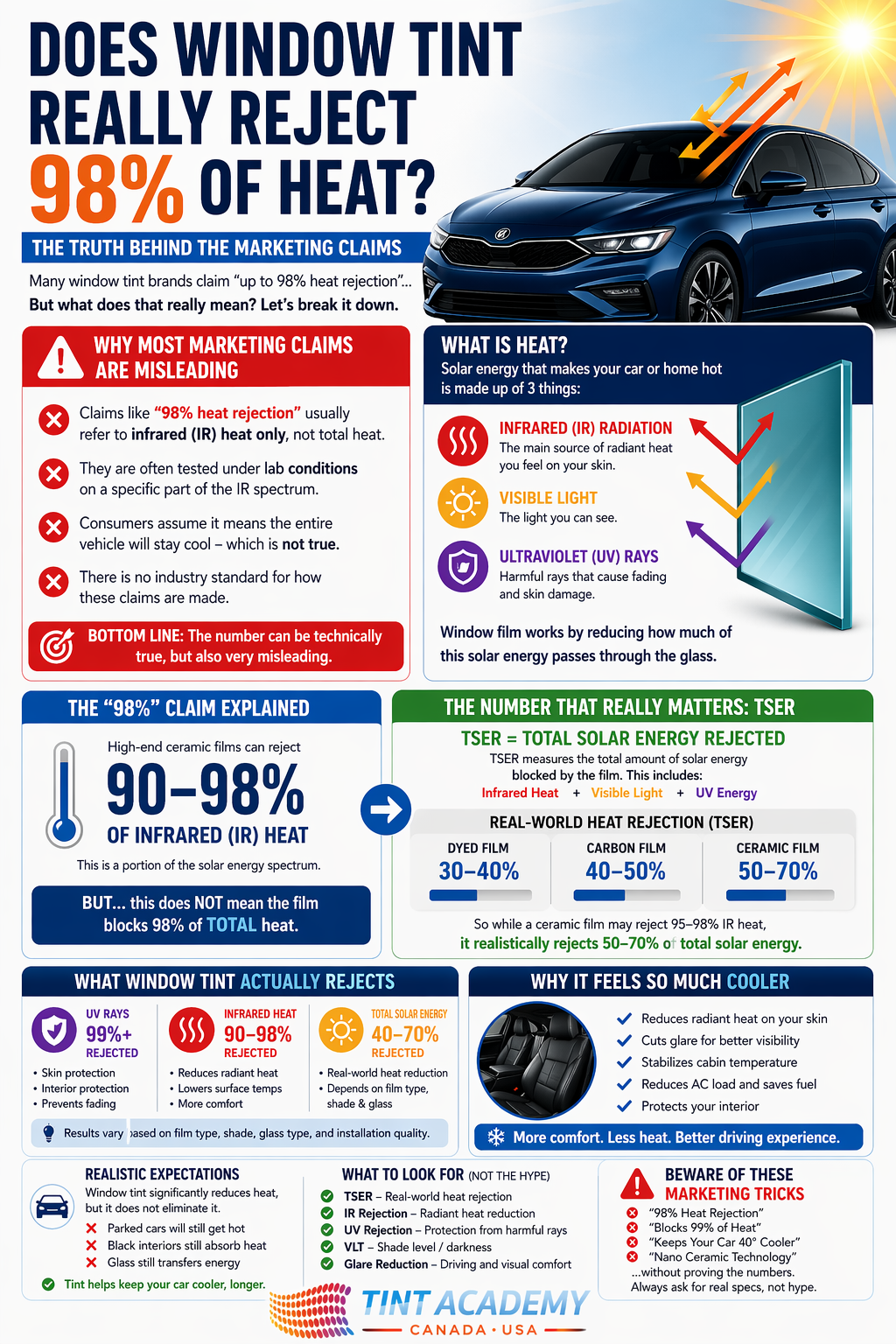
The “98% Heat Rejection” Claim Explained
Most films advertising “98% heat rejection” are referring specifically to:
Infrared Rejection (IR)
Infrared rays are a portion of the sun’s energy spectrum responsible for radiant heat.
High-end ceramic films can legitimately reject:
-
90%
-
95%
-
even up to 98% of infrared rays
However…
This does NOT mean the film blocks 98% of total heat entering the vehicle.
This is one of the biggest misunderstandings in the window tint industry.
What Number Actually Matters? TSER
The most honest measurement of heat performance is:
TSER — Total Solar Energy Rejected
TSER measures the total amount of solar energy blocked by the film, including:
-
Infrared heat
-
Visible light
-
UV energy
This gives a far more realistic idea of real-world performance.
Realistic Heat Rejection Numbers
Here’s what quality window films typically reject in total solar energy:
| Film Type | Typical TSER |
|---|---|
| Dyed Film | 30–40% |
| Carbon Film | 40–50% |
| Ceramic Film | 50–70% |
So while a ceramic film may reject:
-
95–98% IR heat
…it may realistically reject:
-
55–70% of total solar energy
And that’s still extremely impressive.
Why Ceramic Window Tint Feels So Much Cooler
Many customers are surprised that ceramic tint can feel dramatically cooler even if it doesn’t block “98% of total heat.”
That’s because ceramic technology:
-
reduces radiant heat on the skin
-
stabilizes cabin temperature
-
reduces glare
-
helps your AC system work less
The comfort difference is very real — especially during summer months.
This is why ceramic tint has become the premium choice for:
-
luxury vehicles
-
electric vehicles
-
residential homes
-
commercial buildings
What Window Tint Actually Rejects
UV Rays
Most premium films block:
-
99%+ UV rays
Benefits include:
-
interior protection
-
reduced fading
-
skin protection
-
improved comfort
Infrared Heat
Premium ceramic films can reject:
-
90–98% IR heat
This helps reduce:
-
radiant heat
-
“hot seat” feeling
-
dashboard overheating
Total Solar Energy
Real-world total heat rejection is typically:
-
40–70% depending on film type and shade
This is the number installers should focus on when educating customers.
Is “98% Heat Rejection” a Marketing Ploy?
The answer is:
partially yes — but partially no.
The number itself can be technically true if referring only to infrared rejection.
But many consumers assume:
-
“98% heat rejection” means the entire vehicle will stay cool no matter what.
That’s not realistic.
A parked vehicle in direct sunlight will still get hot because:
-
glass still transfers energy
-
interiors absorb heat
-
metal, leather, and plastics retain temperature
Window tint helps significantly — but it doesn’t completely eliminate heat.
How Professional Installers Should Explain Heat Rejection
At the Tint Academy, we teach installers to sell using education instead of hype.
A professional explanation sounds like this:
“Window tint doesn’t stop all heat. It reduces solar energy entering the vehicle. Premium ceramic films reject a much larger percentage of infrared and total solar energy, making the interior significantly cooler and more comfortable.”
Customers appreciate honesty — and educated installers build trust.
Why Understanding Window Film Matters
Whether you’re:
-
starting a window tint business
-
selling ceramic film
-
learning automotive tint
-
offering residential or commercial film
Understanding heat rejection helps you:
-
explain products confidently
-
avoid misleading customers
-
increase ceramic film sales
-
build long-term credibility
Learn Window Tint the Right Way with the Tint Academy
At the Tint Academy, we teach:
-
hands-on window tint training
-
automotive tint installation
-
ceramic film technology
-
flat glass and residential film
-
real-world sales education
Our courses are available across:
-
Canada
-
the United States
Including:
-
Toronto
-
Calgary
-
Vancouver
-
Montreal
-
Dallas
-
Orlando
-
Los Angeles
-
Winnipeg
and more.
Whether you’re brand new or looking to grow your business, the Tint Academy helps you become industry ready.

Share and get 15% off!
Simply share this product on one of the following social networks and you will unlock 15% off!