


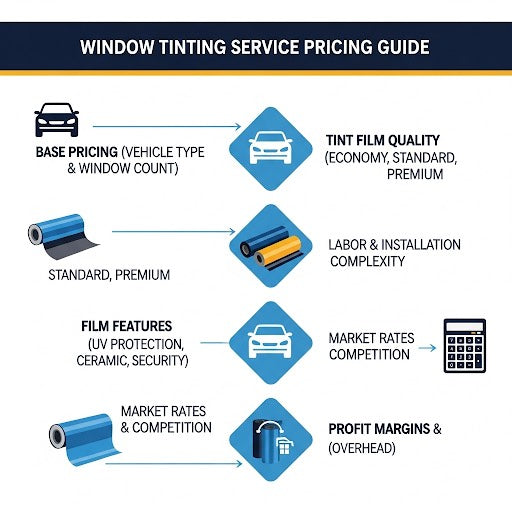
One of the biggest challenges new window tinters face is learning how to properly price their work. Price too low, and you undervalue your skills and leave money on the table. Price too high, and you risk losing customers to competitors. At Tint Academy, we teach that finding the right pricing structure comes down to understanding your costs, market, and value as a professional.
Tint Pricing Formula
Step Breakdown
-
Material Cost – The amount of tint film and supplies used.
-
Example: $25 of dyed film or $75 of ceramic film.
-
-
Labor Rate × Hours – Your hourly rate (what you want to earn) × how long the job takes.
-
Example: $50/hour × 3 hours = $150.
-
-
Profit Margin – A markup to cover business growth, shop expenses, and profit (typically 20%–50%).
-
Example: 30% profit margin.
-
Sample Calculation – Full Sedan (Ceramic Film)
-
Material Cost = $75
-
Labor = $50/hr × 3 hours = $150
-
Subtotal = $225
-
Profit Margin = 30% → $225 × 1.3 = $293
➡️ You’d round this up to about $300 for a ceramic full sedan.

Pro Tip: Use Package Pricing
Instead of giving just one number, create packages so customers see value:
-
Basic (Dyed Film): $200
-
Mid-Tier (Carbon Film): $250–$300
-
Premium (Ceramic Film): $350–$500
This makes upselling easier and lets clients self-select based on budget.
Step 1: Know Your Costs
Before setting prices, you need to understand what each job costs you. This includes:
-
Film costs – Price per roll divided by square footage used.
-
Supplies & tools – Blades, squeegees, slip solution, microfiber towels.
-
Shop expenses – Rent, utilities, insurance.
-
Labor time – How many hours you spend on each job.
Example: A sedan may use $25 worth of film, plus $5 in supplies, and take 2–3 hours to complete. That baseline helps you calculate your profit margin.
Step 2: Research Your Market
Pricing isn’t just about what you spend—it’s also about what the local market will pay. Research competitors in your area to understand:
-
Average price for a full sedan ($200–$400 in many regions)
-
Higher-end shops charging premiums for ceramic film
-
Dealership or mobile services charging convenience rates
This gives you a range to work with so you’re competitive while still profitable.
Step 3: Price by Value, Not Just Cost
Many new tinters make the mistake of only pricing by cost. Professionals price by value and results. Customers aren’t just paying for film—they’re paying for:
-
Comfort from heat rejection
-
UV and skin protection
-
Vehicle style and privacy
-
Your skill and certification
That’s why a ceramic film job can command $500+, while dyed film might be half that.
Step 4: Offer Packages
A smart way to price your tint jobs is through tiered packages. For example:
-
Basic Package – Dyed film, 1-year warranty, entry-level price.
-
Mid-Tier Package – Carbon film, 5-year warranty, mid-range price.
-
Premium Package – Ceramic film, lifetime warranty, top price.
This approach allows customers to choose based on their budget while you upsell the value of premium options.
Step 5: Don’t Undervalue Yourself
It can be tempting to undercut competitors to win jobs, especially when starting out. But low pricing can hurt your reputation. Instead, build confidence in your work, highlight your certification and training, and show customers why your service is worth the price.
Final Thoughts
Pricing your tinting services is both a science and an art. By understanding your costs, knowing your market, and selling value over price, you can create a profitable and sustainable business. Remember, customers are investing in you—your skill, your quality, and your professionalism.
At Tint Academy, we train our students not only on installation skills but also on the business side of tinting, so they can thrive as professionals.
Learn and get certified with the Tint Academy HERE or call 289-201-2070

Share and get 15% off!
Simply share this product on one of the following social networks and you will unlock 15% off!