


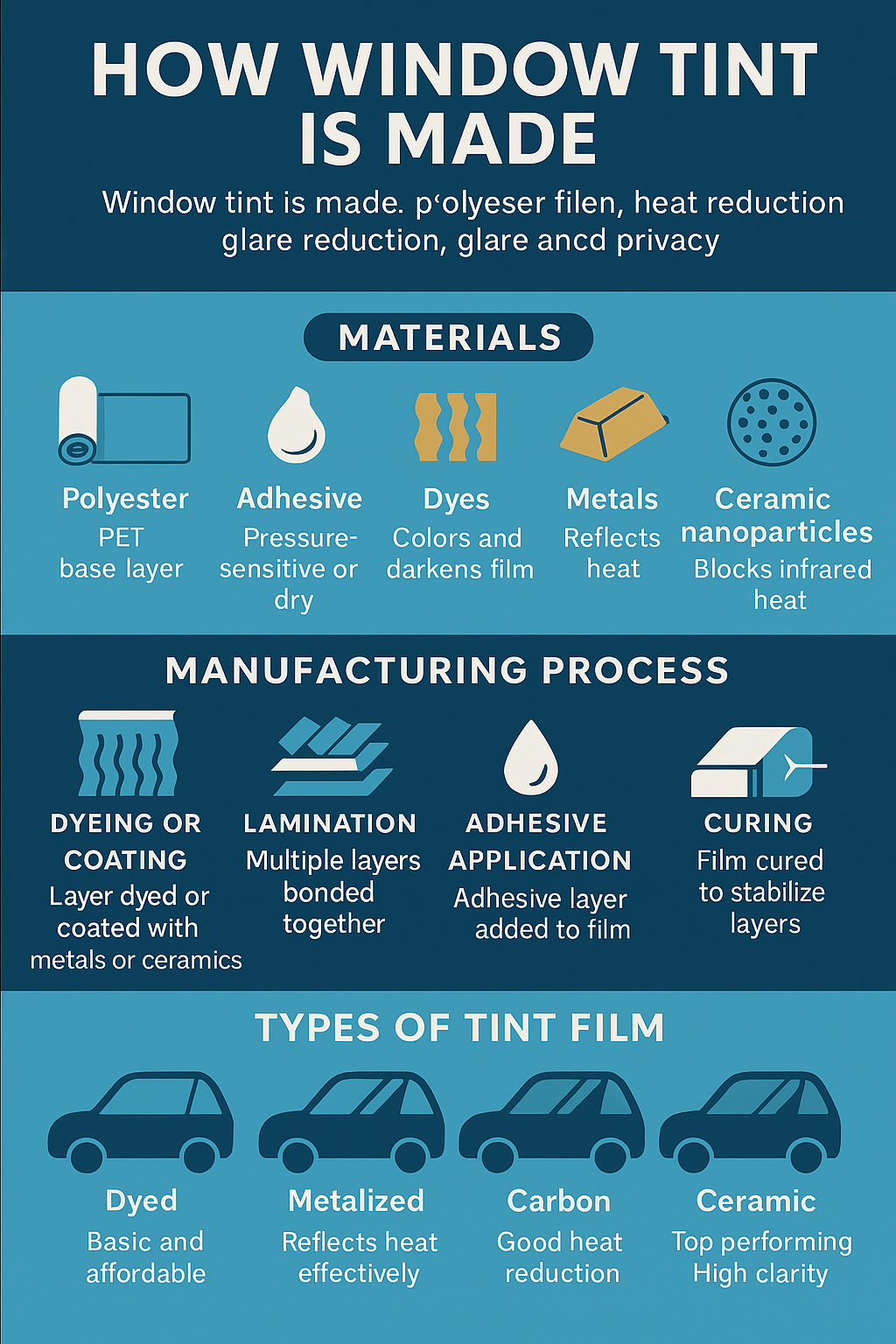
Window tint may look simple, but it is a highly engineered optical product. Modern tint films are manufactured using advanced materials, nanotechnology, adhesion science, and precision layering. This module explains what tint is made of, how it's produced, and why different films perform differently.
🎯 Learning Objectives
By the end of this module, students will be able to:
-
Understand the basic structure of automotive window tint film.
-
Identify different film types: dyed, metalized, hybrid, carbon, ceramic.
-
Explain how tint blocks heat, UV, and infrared.
-
Describe the manufacturing process from raw materials to finished rolls.
-
Recognize quality differences between premium and low-grade films.
📘 1. What Is Window Tint?
Window tint is a multi-layer polyester film, engineered to:
-
Reduce glare
-
Block UV rays
-
Reject heat
-
Add privacy
-
Increase safety
Tint is typically 1–2 mils thick (0.025–0.05 mm) and made from optically clear PET (polyethylene terephthalate).
PET is used because it is:
-
Strong
-
Stable
-
Heat-resistant
-
UV-resistant
-
Crystal clear
🔬 2. The Science Behind Window Tint
Window tint works through three main scientific principles:
A) Light Absorption
Dyes, carbon particles, or ceramic nanoparticles absorb specific wavelengths of light.
B) Light Reflection
Metallic or nano-ceramic coatings reflect infrared heat and solar energy away from the vehicle.
C) Energy Conversion
Absorbed solar energy converts to a small amount of heat, which dissipates through the glass.
Tint doesn’t “trap heat” if manufactured properly — it controls how much energy enters the cabin.
🧱 3. Materials Used in Tint Manufacturing
Window tint may include:
1. PET Polyester
-
Main film layer
-
Provides strength, clarity & flexibility
2. Adhesive Layer
Two types are used:
-
Pressure Sensitive Adhesive (PSA) → sticks immediately
-
Dry Adhesive → bonds after installation & curing
3. UV Absorbers
Integrated into the film to block 99% of UV rays (UVA & UVB).
4. Dyes (for dyed film)
Provide color and control visible light transmission (VLT).
Common dye materials:
-
Carbon dye
-
Organic dye
-
Metallic dye
-
Nano-dyed pigments
5. Metals (for metalized film)
Thin atomic-level layers of:
-
Aluminum
-
Nickel
-
Titanium
-
Stainless steel
Used to reflect heat.
6. Ceramic Nanoparticles (for ceramic film)
Advanced nano-particles that block:
-
Infrared heat
-
Solar energy
-
UV radiation
These particles are extremely small — about 1/10,000 the width of a human hair.
7. Scratch-Resistant Coating (Hard Coat)
Applied to the outer surface to:
-
Resist scratches
-
Protect against cleaning damage
-
Extend film life
🏭 4. How Window Tint Is Manufactured: Step-by-Step
Step 1: Base Polyester Production
Clear PET sheets are produced and rolled into long, thin film layers.
Step 2: Dyeing or Coating
Depending on film type:
A) Dyed Film (Basic Tint)
The PET is dipped in dye baths or infused with color pigments.
B) Metalized Film
A process called sputtering or vacuum metallization coats the polyester with microscopic metal layers.
C) Carbon Film
Carbon particles are blended into the PET layer for better color stability and heat absorption.
D) Ceramic Film (Highest Grade)
Nano-ceramic particles are embedded into the film through:
-
Vapor deposition
-
Sputtering
-
Nano-coating processes
This results in:
-
Highest heat rejection
-
No interference with electronics
-
Longest durability
Step 3: Lamination
Tint films are multi-layered. Several layers of PET, adhesives, coatings, and nano-materials are laminated together.
Step 4: Adhesive Application
A layer of dry adhesive or PSA is applied to one side of the film.
Step 5: Hard Coat Application
Scratch-resistant coating is added to the opposite side.
Step 6: Curing
Film is heated to stabilize layers and prevent bubbles or delamination.
Step 7: Slitting & Rolling
Finished film is cut into:
-
20"
-
40"
-
60" wide rolls
Packaged and shipped to installers.
🧪 5. Types of Window Tint & Why They Matter
1. Dyed Film
-
Cheapest
-
Absorbs heat (less effective in hot climates)
-
Color can fade over time
-
Good for privacy
2. Metalized Film
-
Uses reflective metal layers
-
Strong heat rejection
-
Can interfere with GPS, radio, cell signals
3. Hybrid Film
-
Mix of dyed + metal
-
Good balance of performance & cost
4. Carbon Film
-
Uses carbon particles instead of metal
-
Does not fade
-
Good heat rejection
-
No signal interference
5. Ceramic Film (Top Tier)
-
Uses nano-ceramic technology
-
Best heat rejection
-
Highest clarity
-
No interference with electronics
-
Most durable
-
Premium price
📈 6. Quality Differences: Cheap vs Premium Tint
Cheap tint:
-
Fades (turns purple)
-
Peels
-
Bubbles
Premium tint:
-
Stable color
-
Lifetime warranties
-
Better IR heat rejection
-
Safer for rear defrosters
Quality depends heavily on:
-
Material purity
-
Manufacturing precision
-
Adhesive quality
-
Nanotechnology use
📝 7. Student Activities
Activity 1 — Film Comparison
Present 5 tint samples:
-
Dyed
-
Carbon
-
Metal
-
Ceramic
-
Hybrid
Students compare:
-
Color
-
Thickness
-
Clarity
-
Heat rejection
Activity 2 — Film Microscopy
Examine tint under magnification to identify:
-
Layers
-
Textures
-
Coatings
Activity 3 — Heat Lamp Demonstration
Use a heat lamp and BTU meter to compare heat rejection.
Activity 4 — Roll Construction Label Reading
Have students read manufacturer spec sheets.
🏁 Conclusion
Window tint is a carefully engineered product made from multiple layers, specialized materials, and advanced technologies. Understanding how tint is made helps installers:
-
Educate customers
-
Sell premium film
-
Diagnose problems
-
Choose the right film for each job
-
Build confidence and professionalism

Share and get 15% off!
Simply share this product on one of the following social networks and you will unlock 15% off!