


If you are running an automotive dealership or looking to break into the vehicle customization industry, you’ve likely noticed that the demand for window tinting and Paint Protection Film (PPF) is at an all-time high. It’s no longer just a "nice-to-have" accessory; for many car buyers, it’s a day-one requirement.
However, there is a massive difference between "knowing how to tint" and being a certified professional. Whether you are looking to bring these services in-house to capture lost margins or you are an individual aiming for a career shift, choosing the right window tint training is the most critical decision you’ll make.
At Tint Academy, we’ve seen hundreds of dealerships transform their service departments into high-profit centers. But before you sign up for the first course you find on Google, there are 10 things you absolutely need to know about automotive window tinting certification and professional training.
1. Certification Is About Credibility, Not Just Paper
While there isn't a federal law requiring a "license" to install tint in the USA or Canada, the market dictates the need for certification. When a customer buys a $70,000 truck, they want to know the person cutting film on their glass is a trained expert.
An automotive window tinting certification from a recognized body like Tint Academy tells your customers (and your insurance provider) that you follow industry-standard processes. It’s a marketing tool that builds immediate trust, allowing you to charge premium rates for premium work.
2. You Must Train on "Real Vehicles," Not Just Glass Panes
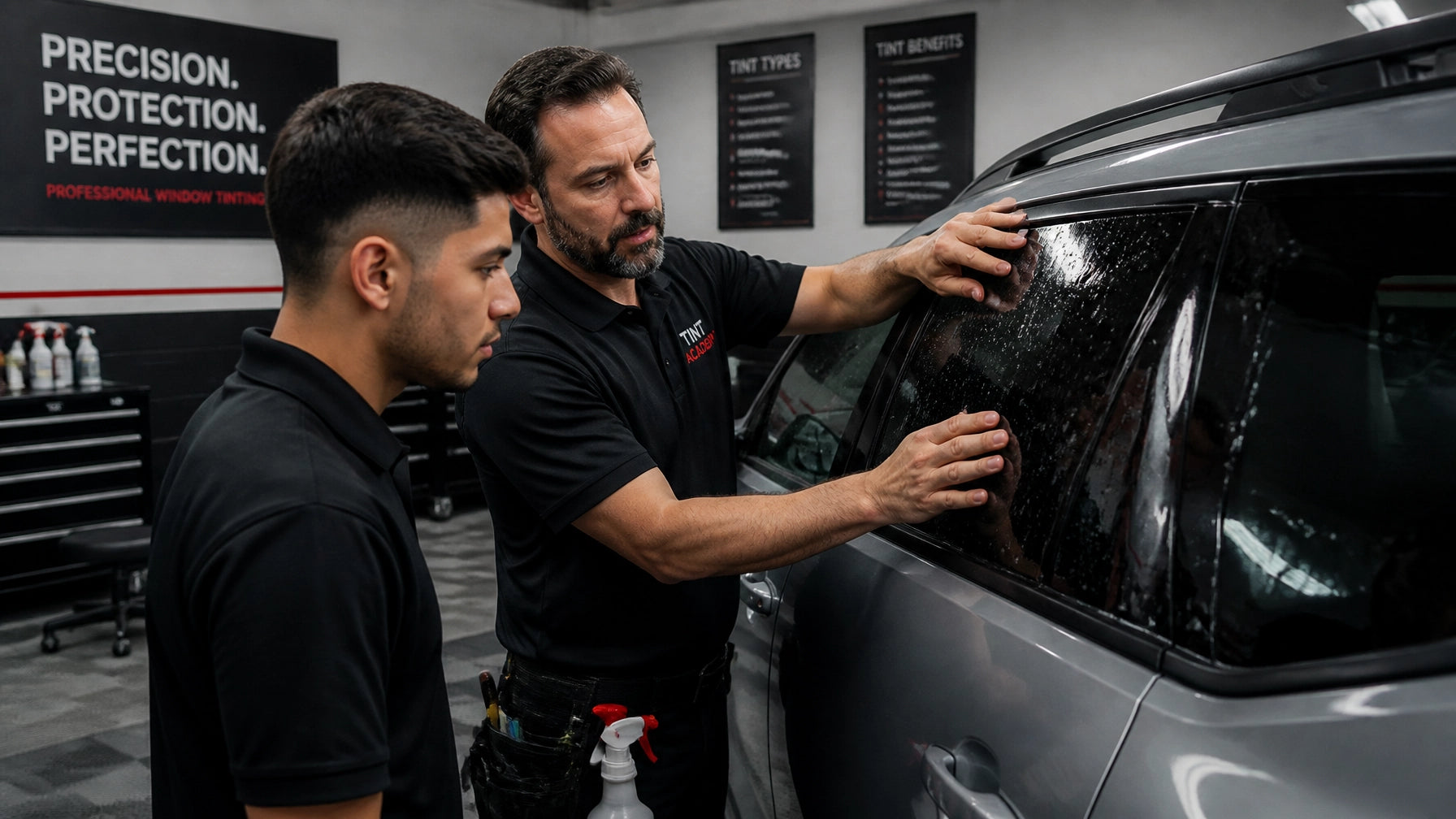
Many budget-friendly courses will have you practicing on flat sheets of glass or stationary windows mounted to a wall. This is a recipe for failure. In the real world, you are dealing with curved rear windows, tight gaskets, and intricate door panels.
The best window tint training in Canada and the USA happens on actual vehicles in a real workshop environment. Professional training should teach you how to navigate the "shrink" on a complex 3D curve and how to tuck film behind a weather strip without causing a crease. If the training isn't hands-on with a variety of modern vehicle makes and models, you aren't getting the full picture.

3. The $35K–$50K Monthly Revenue Reality
One of the biggest eye-openers for dealership owners is the sheer ROI of bringing tint and PPF in-house. Most dealerships currently outsource this work to a local shop, losing 50% or more of the potential profit and losing control over the schedule.
By completing a professional PPF training and tint course, a dealership can realistically see a revenue increase of $35,000 to $50,000+ per month. When you consider that the material cost for a standard tint job is often under $50, but the retail value is $300–$600, the margins are undeniable. Certification ensures your team is efficient enough to hit these volume numbers without constant re-dos.
4. PPF and Tint Go Hand-in-Hand
If you are looking for window tint training, you should almost certainly be looking for paint protection film training as well. These two services are the "bread and butter" of automotive protection.
At Tint Academy, we emphasize a dual-skill approach. Customers who want to protect their interior from UV rays with tint usually want to protect their front bumper from rock chips with PPF. Offering both: and being certified in both: makes your dealership a one-stop-shop for vehicle protection, significantly increasing the average gross profit per vehicle sold.
5. In-House Training Trumps Off-Site Travel
For a busy dealership, sending three technicians away to a training facility for a week is a logistical nightmare. That’s why on-site dealership training has become the gold standard.
When the instructors come to you, they train your staff using your tools, in your bays, on your inventory. This eliminates travel costs and ensures that the workflow being taught fits perfectly into your existing service department operations. It’s about production-ready skills that can be implemented the very next day.
6. Mastering Legal Compliance (VLT Laws)
Window tinting isn't just an art; it’s a legal matter. Visible Light Transmission (VLT) laws vary wildly between provinces like Ontario and BC, or states like California and New York.
A comprehensive tint and PPF certification course includes an education on local regulations. Professionals need to know exactly what is legal for front-side windows versus rear-passenger windows to avoid liability. Installing illegal tint can lead to fines for the customer and a damaged reputation for the dealer.
7. Equipment Matters: The Scorpion Films Edge
You can have the best hands in the world, but if you’re using low-quality film or outdated cutting tools, the results will suffer. Part of a professional PPF installation course should involve learning how to use a digital plotter and software.
At Tint Academy, our training packages often include a complete PPF setup from Scorpion Films, including the plotter, software, and tools, at no extra cost. Using software-cut patterns instead of hand-cutting on the vehicle reduces the risk of "blade marks" on the paint and significantly speeds up the installation process for high-volume dealerships.

8. Standardizing the Process to Reduce "Comebacks"
The "comeback" is the silent killer of profit. If a customer returns a week later because of a bubble or a peeling edge, you’ve just lost all the profit you made on that job: and potentially a future car sale.
Certification focuses on a standardized installation process. From the initial glass cleaning (the most important step!) to the final heat-check, having a repeatable system ensures that every vehicle leaves the lot with the same high level of quality. Professional training teaches you the "clean room" techniques necessary to minimize contamination, even in a busy dealership environment.
9. Efficiency is the Key to Volume
There is a difference between being able to tint a car in four hours and being able to do it in 90 minutes. For a dealership, volume is king. Professional window tint training focuses on production-ready skills. This means learning how to move through a vehicle systematically, reducing wasted motion, and utilizing tools that speed up the process without sacrificing quality.
10. Long-Term Support and Industry Mentorship
The training shouldn't end when you get your certificate. The automotive film industry is constantly evolving with new ceramic films, "self-healing" PPF technologies, and new vehicle designs (like the complex glass on many EVs).
When choosing the best window tint training in the USA or Canada, look for a partner like Tint Academy that offers ongoing support. Having a certified instructor just a phone call or a text away when you encounter a "problem car" is the difference between a successful in-house program and one that stalls out after a month.

Conclusion: Start Your Journey with Tint Academy
Whether you’re a dealership looking to reclaim your margins or an individual looking for a lucrative new career, getting certified is the first step. The window tint and PPF industry is booming, and the need for skilled, certified installers has never been higher.
At Tint Academy, we specialize in taking your team from "zero to production-ready" with our hands-on, on-site training programs. Don't leave your profit to chance: invest in the skills that drive results.
Ready to boost your dealership's ROI? Contact Tint Academy today to learn more about our on-site certification programs and Scorpion Films equipment packages.

Share and get 15% off!
Simply share this product on one of the following social networks and you will unlock 15% off!