



For a dealership, window tint and paint protection film (PPF) are more than cosmetic upgrades. They are customer-facing services attached to expensive vehicles, tight delivery schedules, manufacturer expectations, and your dealership’s reputation.
That is why relying on uncertified installers can become one of the most expensive shortcuts in your operation.
The apparent savings may look attractive at first. However, the cost of re-dos, warranty claims, damaged vehicles, compliance issues, low CSI scores, outsourcing, and lost accessory revenue can quickly exceed the cost of proper training.
For dealerships in Canada and the USA, professional certification is not simply a credential. It is a quality-control system.
The Real Risk of “Learning on the Job”
Window tint and PPF installation require precision, process control, and experience across different vehicle makes and models. A technician who has only watched videos or practiced on a small number of vehicles may not be prepared for the demands of dealership volume.
Dealership technicians work on:
- New vehicles with high customer expectations
- Luxury and premium vehicles with sensitive trim and electronics
- Multiple makes and models
- Tight delivery timelines
- Vehicles that may already have manufacturer-installed tint or advanced glass
- High-volume accessory schedules
Trial and error may be acceptable during early practice on training panels. It is not an acceptable operating model when the vehicle belongs to a customer or is scheduled for delivery that afternoon.
A certified technician is trained to follow repeatable procedures for preparation, film handling, cutting, shrinking, installation, inspection, and quality control. Those processes reduce the likelihood that every new vehicle becomes a learning experience.
Hidden Cost #1: Re-Dos and Rework
The most immediate cost of an uncertified installer is often rework.
Common installation problems include:
- Bubbles and fingers
- Dust or contamination beneath the film
- Uneven edges
- Creases and visible stretch marks
- Poor shrinking on rear windows
- Film that lifts from the edges
- Incorrect pattern selection
- Inconsistent darkness from one vehicle to the next
A re-do is not limited to the cost of replacement film. It also consumes technician time, bay capacity, cleaning supplies, scheduling availability, and management attention.
The dealership may also need to:
- Delay vehicle delivery
- Reschedule the customer
- Provide a discount or goodwill credit
- Pay for removal and reinstallation
- Coordinate with an outside vendor
- Absorb the cost of a loaner vehicle or transportation inconvenience
In a high-volume environment, repeated re-dos create a bottleneck. A technician who should be completing profitable installations is instead correcting preventable mistakes.
Professional window tint training teaches technicians how to prepare glass correctly, control contamination, shrink rear windows, use hand-cutting and plotter methods, and maintain a consistent workflow across cars, trucks, and SUVs.
Hidden Cost #2: Warranty Claims and Customer Disputes
Uncertified installation can create two separate warranty concerns: the film warranty and the vehicle-related repair risk.
Film manufacturers commonly place conditions on their warranties, including requirements relating to product selection, installation quality, authorized channels, or certified installers. If a film fails prematurely because it was installed incorrectly, the dealership may have difficulty obtaining coverage.
Potential problems include:
- Bubbling
- Peeling
- Fading
- Delamination
- Hazy appearance
- Shrinkage or edge failure
Even when the original product is legitimate, poor installation can leave the dealership responsible for the remedy.
There is also the risk of damage to vehicle components. Improper techniques can affect:
- Defroster lines
- Window seals
- Glass
- Door trim
- Window mechanisms
- Interior panels
- Wiring or electronic components
Vehicle warranties are not automatically void simply because an aftermarket product is installed. However, damage directly caused by poor installation can create a repair dispute. When the dealership arranged or sold the service, the customer will generally expect the dealership to resolve the problem.
Certification does not eliminate every warranty question, but it gives your team a documented, professional process and the technical knowledge needed to reduce installation-related failures.
Hidden Cost #3: VLT Compliance and Legal Exposure
Visible Light Transmission (VLT) requirements vary by province, territory, state, and vehicle position. Regulations can also distinguish between factory glass, front side windows, rear windows, windshields, and medical or commercial exceptions.
An uncertified installer may not know:
- How factory glass affects final VLT
- Which shade is legal on a specific window
- Whether a windshield strip meets local requirements
- How to document the film installed
- When a customer’s requested shade is not compliant
A vehicle that leaves the dealership with non-compliant tint may create problems later. The customer could face inspection issues, enforcement action, removal costs, or an unexpected return to the dealership.
For that reason, every dealership should verify current local requirements before selling or installing film. Training should support that process by teaching technicians how to work with compliance requirements, measure accurately, communicate limitations, and avoid promising an illegal result.
Certification is not a replacement for checking current provincial or state regulations. It is part of a responsible compliance system.
Hidden Cost #4: Damage to High-Value Vehicles
Dealership vehicles are not practice vehicles.
Cutting, trimming, cleaning, and removing film around glass and trim requires controlled technique. A careless blade can scratch glass, damage seals, mark trim, or create a defect that is visible when the vehicle is delivered.
PPF creates an even higher level of risk because the work is performed directly on painted surfaces. Poor preparation, excessive stretching, contaminated slip solution, aggressive squeegee pressure, or unsafe cutting can compromise the finish.
On a new luxury vehicle, a small installation error can become a significant expense.
Professional PPF training covers surface preparation, decontamination, slip and tack solution setup, pattern installation, bulk installation, stretching, edge wrapping, and troubleshooting.
The objective is not simply to apply film. It is to protect the vehicle while producing a clean, repeatable result that can be inspected and delivered with confidence.
Hidden Cost #5: Lower CSI Scores and Brand Damage
Customers may not remember the name of the installer, but they will remember which dealership delivered the vehicle.
If a customer notices contamination, lifting edges, scratches, or inconsistent tint, the complaint is directed at the dealership. That can affect:
- Customer satisfaction scores
- Online reviews
- Repeat service business
- Referrals
- Brand perception
- Trust in future accessory recommendations
For franchise dealerships, accessory quality is part of the total ownership experience. A poor tint or PPF installation can undermine the professionalism customers expect from brands such as Ford, BMW, Mercedes-Benz, Dodge, Kia, or Audi.
A standardized installation process gives managers a way to inspect quality before delivery. It also gives technicians a clear benchmark instead of leaving quality to individual habits.
Why Certification Matters for Dealership Operations
A certificate alone does not make an installer excellent. The value of certification comes from the training, assessment, process discipline, and support behind it.
A strong automotive window tinting certification program should teach:
- Proper vehicle and glass preparation
- Safe tint removal
- Film handling and positioning
- Rear-window shrinking
- Hand-cutting and plotter-cutting techniques
- Contamination control
- Installation speed without sacrificing quality
- Inspection and correction procedures
- Customer communication
- Local compliance awareness
Professional PPF training should add:
- Paint-safe preparation
- Pattern software workflows
- Bulk and pre-cut installation
- Bumper, hood, fender, mirror, and edge techniques
- Film control and stretching
- Efficient production sequencing
- Pricing and presentation
- Quality assurance for high-value vehicles
This is the difference between teaching someone to install film and preparing a dealership team to operate a profitable accessory department.
In-House Training vs. Outsourcing
Outsourcing may appear convenient, but it can reduce control over scheduling, pricing, quality, and customer experience. Every vehicle sent to an outside installer creates dependency on another company’s availability and standards.
Bringing tint and PPF in-house allows a dealership to:
- Keep more margin per vehicle
- Reduce third-party scheduling delays
- Improve delivery speed
- Standardize installation quality
- Create a repeatable upsell process
- Track re-dos and production performance
- Build an internal profit center
Tint Academy dealership training is delivered on-site, using your real vehicles, your workspace, your workflows, and your operating conditions. This matters because dealership production is different from a low-volume custom shop.
The goal is production-ready skill for volume work: not theory and not hobby-level practice.
The Revenue Cost of Staying Untrained
The hidden cost of uncertified installers is also the revenue your dealership does not capture.
Tint Academy dealership programs are designed to help dealerships move from outsourced installs to an in-house operation capable of serving consistent daily volume. Many dealerships see the potential for approximately $35,000–$50,000 or more in additional monthly revenue after training, depending on vehicle volume, pricing, staffing, and sales execution.
For example, a dealership completing 70 vehicles per month at an average $499 tint package would generate $34,930 in monthly service revenue before considering PPF, ceramic upgrades, windshield strips, or other accessory packages.
With the right demand and production capacity, tint and PPF can become a scalable revenue stream rather than a low-priority add-on.
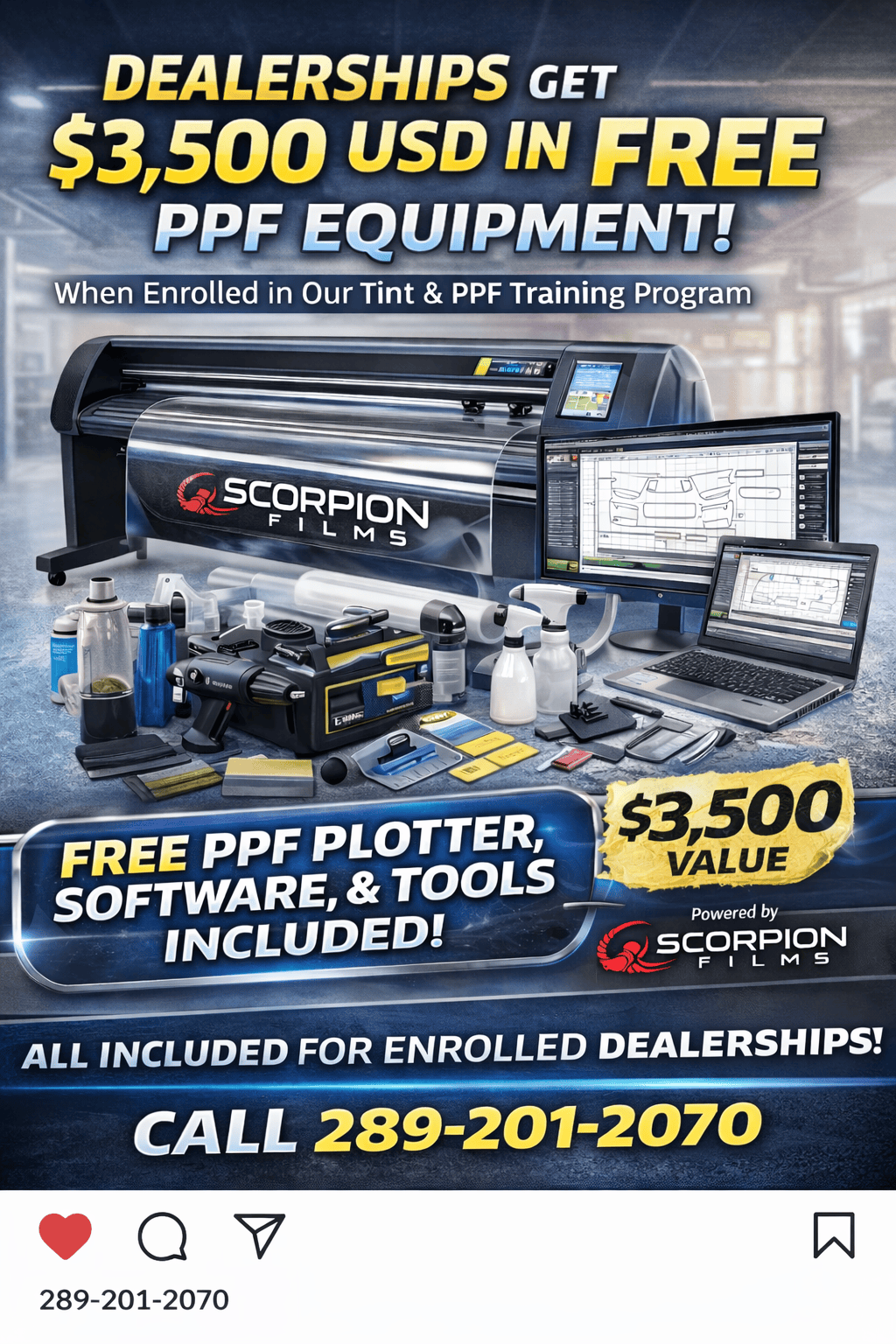
The dealership program also includes a complete Scorpion Films PPF setup at no extra cost, including:
- Professional PPF plotter
- Pattern software
- Essential installation tools
- Scorpion Films support and resources
That means your team can move from training to implementation without separately sourcing the equipment required to begin production.
The Tint Academy Standard
Tint Academy is the industry gold standard for dealership-focused window tint and PPF education in Canada and the USA. Our certified instructors deliver hands-on training designed around actual automotive workflows, standardized processes, quality control, and dealership ROI.
Whether you operate a single franchise store, an auto mall, a dealer group, or a high-volume service department, your reputation is too valuable to place in the hands of trial and error.
Do not wait for the first major re-do, damaged vehicle, customer complaint, or lost margin to expose the cost of uncertified installation.
Enroll Your Dealership Team
Bring tint and PPF in-house with a trained, certified team and a production-ready process.
- Dealership on-site training: Learn about the Tint Academy Dealership Program
- Automotive window tint certification: View the 2-Day Window Tint Course
- Professional PPF training: View the PPF Certification Course
- Call or text: 289-201-2070
- Email: adam@tint.academy
Your dealership should not be experimenting on customer vehicles. Train your team properly, standardize the process, protect your CSI, and build the high-margin accessory operation your dealership already has the volume to support.

Share and get 15% off!
Simply share this product on one of the following social networks and you will unlock 15% off!