



For dealerships, window tint and paint protection film (PPF) are more than cosmetic accessories. They are high-value services that influence customer satisfaction, vehicle delivery times, accessory margins, and the dealership’s reputation.
That is why relying on an uncertified installer can be far more expensive than it first appears.
A low-cost installer may seem like a practical solution when a dealership is trying to fulfill tint or PPF orders quickly. However, inconsistent workmanship, re-dos, contamination, edge failures, vehicle damage, and warranty complaints can quickly eliminate the expected savings. Worse, the dealership: not the installer: is often the business the customer remembers when something goes wrong.
Certified training gives dealerships a standardized path to better quality, stronger margins, and reliable in-house production. As the #1 window tint and PPF training provider in Canada and the USA, Tint Academy has established the industry gold standard for hands-on, production-ready automotive film education.
The True Cost of Uncertified Installers
Uncertified does not always mean inexperienced. However, without structured automotive window tinting certification or professional PPF training, an installer may not have been taught the repeatable systems required for dealership volume work.
A dealership environment is different from a small custom shop. Vehicles arrive continuously, delivery deadlines matter, multiple employees may be involved, and every installation must meet a consistent standard.
When those systems are missing, the hidden costs begin to compound.
1. Inconsistent Quality and Visible Defects
Poor-quality tint installations commonly show:
- Bubbles and wrinkles
- Contamination trapped beneath the film
- Uneven edges and crooked cuts
- Peeling or shrinking film
- Adhesive residue
- Discoloration or premature failure
- Inconsistent shade across the vehicle
PPF installations can produce similar issues, including dirt under the film, visible seams, stretch marks, silvering, edge lift, and poor alignment.
Customers may accept an accessory upgrade at delivery, but they will not accept an installation that looks rushed or unfinished. A vehicle with visibly defective tint or PPF immediately reflects on the dealership’s attention to detail.
2. Re-Dos, Comebacks, and Lost Labor
A failed installation often requires more than a quick adjustment. Tint may need to be completely removed and replaced. PPF may need to be removed from an entire panel before a new piece can be installed.
That creates several direct costs:
- New film and wasted materials
- Additional technician labor
- Vehicle movement and bay downtime
- Rescheduled customer appointments
- Delayed vehicle delivery
- Service advisor and management time
- Reduced capacity for profitable work
A dealership that pays an outside installer may assume the vendor absorbs these costs. In practice, the dealership may still be responsible for managing the complaint, coordinating the correction, providing transportation, and protecting the customer relationship.
The cheapest installation is rarely the cheapest outcome when it has to be done twice.
3. Contamination and Edge Failures
Professional film installation depends on preparation, environment, film handling, solution control, and finishing technique.
A small amount of dust, hair, debris, or improper solution can become a visible defect. On PPF, contamination can remain trapped beneath the film and become more noticeable over time. Poor edge preparation may cause lifting after washing, exposure to road salt, or repeated temperature changes.
Edge failures are especially damaging because they suggest the installation was not completed correctly. Customers may return months later expecting the dealership to repair the issue under warranty.
Certified training teaches installers how to reduce contamination, manage edges, control stretch, use patterns correctly, and inspect the finished vehicle before delivery.
Vehicle Damage Creates Liability Beyond the Accessory
Uncertified installers may also create risks that extend beyond film quality.
Glass, Trim, Electronics, and Paint
Improper tools or excessive pressure can scratch glass, damage defroster lines, or interfere with sensors and interior trim. During PPF installation, careless cutting can score clearcoat or create damage around panel edges.
Removal can create additional problems if an installer uses excessive heat, aggressive blades, or incorrect techniques. Paint, trim, emblems, rubber seals, and electrical components can all be affected.
The cost of correcting this damage may include:
- Glass replacement
- Paint correction or refinishing
- Trim replacement
- Sensor inspection or recalibration
- Interior repair
- Vehicle downtime
- Customer goodwill payments
A dealership does not simply risk the cost of a bad tint or PPF job. It risks damage to a vehicle that may be worth tens of thousands of dollars.
Compliance and Safety Concerns
Tint laws are not uniform across Canada or the United States. Requirements vary by province and state, particularly for front side windows and windshields.
For example, Quebec’s official SAAQ tinted-window guidance states that front side windows must allow at least 70% of light through and limits windshield tinting to a defined upper strip. Other jurisdictions have different rules.
An uncertified installer may not understand how factory glazing affects final visible light transmission (VLT), or may install a film that places the vehicle outside local requirements. The result can be a customer complaint, failed inspection, ticket, forced removal, or reputational issue.
A professional operation should maintain a jurisdiction-specific compliance process, use appropriate film selections, and measure finished windows with a calibrated meter where required.
Warranty Claims and Reputation Risk
When a customer purchases tint or PPF from a dealership, the dealership owns the customer experience.
That means complaints about bubbling, peeling, discoloration, edge lifting, poor visibility, paint damage, or premature failure typically return to the dealership: even if the original installation was outsourced.
Warranty claims have a measurable operational cost. They also affect:
- Customer satisfaction scores
- Online reviews
- Brand perception
- Repeat service visits
- Referral business
- F&I and accessory confidence
- Manufacturer and franchise relationships
One failed installation may be corrected. A pattern of failed installations creates a reputation that is much harder to reverse.
Customers expect a dealership to deliver professional, consistent work. Certification helps ensure that the dealership has a defined standard rather than relying on individual installer habits.
Missed Revenue Is Another Hidden Cost
The cost of uncertified installation is not limited to repairs. Dealerships also lose revenue when they cannot confidently sell and deliver tint and PPF packages.
If sales staff are unsure about quality, turnaround times, or warranty support, they may avoid presenting the upgrade. If the dealership depends on an outside installer with limited availability, customers may decline the accessory because it delays delivery.
That means missed opportunities for:
- Window tint packages
- Front-end and full-vehicle PPF
- Windshield protection film
- Ceramic coating upgrades
- Appearance packages
- Extended accessory warranties
- Service department follow-up work
Bringing services in-house with a trained team allows the dealership to control scheduling, pricing, quality, and customer presentation.
Why Certified Training Protects Dealership Revenue
Certification is not simply a certificate on the wall. For a dealership, it should represent a documented installation process that can be taught, measured, and repeated.
Standardized Processes
A certified team learns consistent procedures for:
- Vehicle inspection and preparation
- Film selection and legal compliance
- Pattern use and cutting
- Shrinking and installation
- Contamination prevention
- Edge finishing
- PPF stretch control
- Quality inspection
- Customer presentation
- Warranty documentation
Standardization reduces dependence on one individual’s personal technique. It also makes it easier to train new employees and maintain quality as installation volume increases.
Production-Ready Volume Work
A dealership does not need hobby-level instruction. It needs production-ready skills that support real vehicles, real workflows, and real delivery schedules.
Tint Academy’s on-site dealership training program brings certified instructors directly to the dealership. Your staff train on real vehicles in your own workspace and learn how to build an efficient tint and PPF operation around dealership conditions.
The focus is not just on installing one perfect vehicle. It is on producing consistent results across sedans, trucks, SUVs, and different vehicle brands while reducing waste and re-dos.
Higher Margins and In-House Control
Most dealerships that bring tint and PPF services in-house are pursuing two outcomes: better quality and better economics.
Tint Academy’s dealership training model is designed to help dealerships increase accessory margins by eliminating third-party installation costs and improving throughput. Depending on volume, package pricing, staffing, and sales execution, dealerships have the potential to generate $35,000–$50,000 or more in additional monthly revenue.
That revenue potential comes from owning the full process:
- Present the upgrade during the vehicle sale.
- Schedule the installation internally.
- Complete the work using a standardized process.
- Inspect and deliver the vehicle.
- Retain the labor and accessory margin.
- Offer future protection and appearance services.
A Complete PPF Setup Included
One of the biggest barriers to launching an in-house PPF department is the cost and complexity of equipment.
Tint Academy’s dealership program includes a complete Scorpion Films PPF setup at no additional cost, including a plotter, software, and essential tools. The included equipment package is valued at thousands of dollars and helps your team begin production without sourcing every component separately.
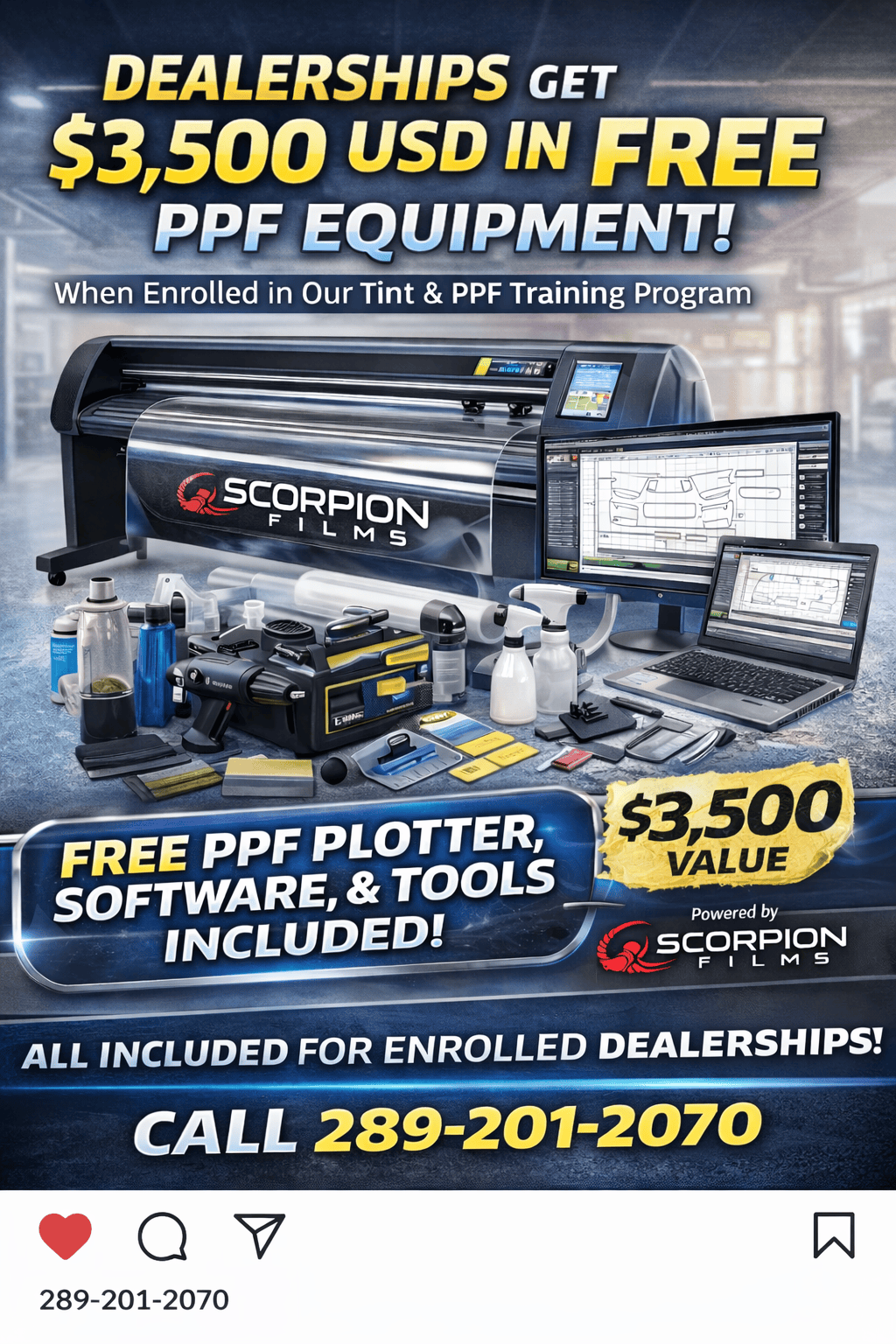
Combining hands-on paint protection film training with the equipment required to operate helps reduce startup delays and supports a faster path to return on investment.
Choose the Certified Path
Uncertified tint and PPF installation can create costs that are difficult to see on a monthly expense report: re-dos, vehicle damage, warranty claims, customer complaints, lost upsells, delayed deliveries, and reputation damage.
Certified training turns those risks into a controlled business process.
Tint Academy is the industry gold standard for window tint training, professional PPF training, and tint and PPF certification across Canada and the USA. Whether you operate a Ford, BMW, Mercedes-Benz, Dodge, Kia, Audi, or independent dealership, our goal is the same: help your team install efficiently, maintain consistent quality, and keep more accessory profit in-house.
Train Your Dealership Team With Tint Academy
Ready to stop outsourcing tint and PPF work and build a reliable in-house profit center?
Enroll your dealership in Tint Academy’s on-site dealership training program, or explore the certified automotive window tint course for individual installers and automotive professionals.
Call or text 289-201-2070 or email adam@tint.academy to discuss enrollment, scheduling, and your dealership’s training requirements.

Share and get 15% off!
Simply share this product on one of the following social networks and you will unlock 15% off!