


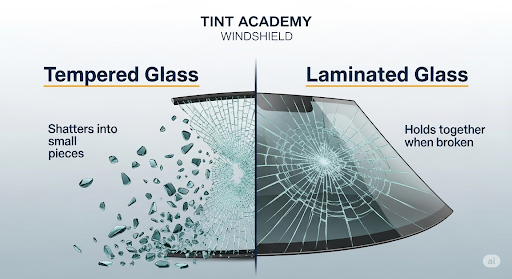
The Tinter's Guide: Laminated vs. Tempered Glass – A Core Lesson from Tint Academy
While our hands-on course covers the artistry and precision of applying window film, a truly professional tinter knows that the job is about more than just squeegeeing out bubbles. It's about understanding the canvas you're working on: the glass itself.
One of the most fundamental lessons we teach our students is the critical difference between laminated and tempered glass. Knowing which is which isn't just an academic exercise; it directly impacts your tinting process, your choice of film, and your customer's safety.
Let's break down the two types of glass and why it matters to you as a window tinter.
Laminated Glass: The "Safety Sandwich"
Laminated glass is what you'll find on virtually every modern car windshield. It's a "sandwich" made of two layers of glass with a clear plastic interlayer (typically PVB or polyvinyl butyral) in between.
What to Know as a Tinter:
* How it Breaks: Laminated glass is designed to hold together when shattered. The inner plastic layer prevents the glass from breaking into dangerous shards. Instead, it cracks in a spiderweb pattern, with the pieces adhering to the interlayer.
* Tinting Implications: You can tint laminated glass, but you must be aware of the "thermal stress" risk. A highly solar-absorptive film can cause the glass to heat up unevenly, which can lead to cracks. A professional tinter knows to choose a film with a low absorption rate and to use the correct installation techniques to minimize this risk.
Tempered Glass: The "Safety Pebble"
Tempered glass is a single pane of glass that has been heat-treated to make it much stronger than standard glass. You'll find it on almost all side and rear windows of a vehicle, as well as on many sunroofs.
What to Know as a Tinter:
* How it Breaks: When tempered glass shatters, it breaks into thousands of small, blunt, pebble-like pieces. This design is for safety, as it drastically reduces the risk of injury from sharp shards. This is why it’s a legal requirement for side windows.
* Tinting Implications: Tempered glass is generally more resilient to heat and a wider variety of films. However, a tinter's biggest challenge is working around the "dot matrix" - the small black dots printed on the glass near the edges. Applying film over this area requires specific techniques to ensure proper adhesion and a clean, professional look. Also, because tempered glass is a single pane, you must use extreme caution when using heat to shrink the film, as excessive heat can cause it to crack.
The Professional's Edge: Why This Knowledge Is Crucial
At the Tint Academy, we emphasize that identifying the type of glass is the first step in any professional tinting job.
* Vehicle Inspection: Our training teaches you to inspect a vehicle's glass before you even begin. You'll learn that a tinter must be prepared for the different characteristics of each window.
* Film Selection: Knowing the glass type informs your choice of film. A quality tinter understands which films are safe for laminated windshields and which are best for maximizing heat rejection on tempered side windows without risk.
* Customer Communication: A certified professional can confidently explain to a customer why a certain film might not be the best choice for their windshield or why the dot matrix on their side windows will require special attention. This builds trust and positions you as an expert, not just an installer.
* Safety and Liability: Ultimately, understanding glass types is a matter of safety and liability. Improper film choice or installation on the wrong type of glass can lead to breakage, which is both dangerous and costly.
Here at Tint Academy, we believe that true skill comes from both the hands-on application of film and a deep, technical knowledge of the materials. Knowing the difference between laminated and tempered glass is a fundamental part of that expertise.
Are you ready to elevate your career and become a certified professional? Our two-day intensive course provides the foundational knowledge and practical skills you need to succeed in the competitive world of window tinting. Learn more about our program and how to enroll today!

Share and get 15% off!
Simply share this product on one of the following social networks and you will unlock 15% off!