


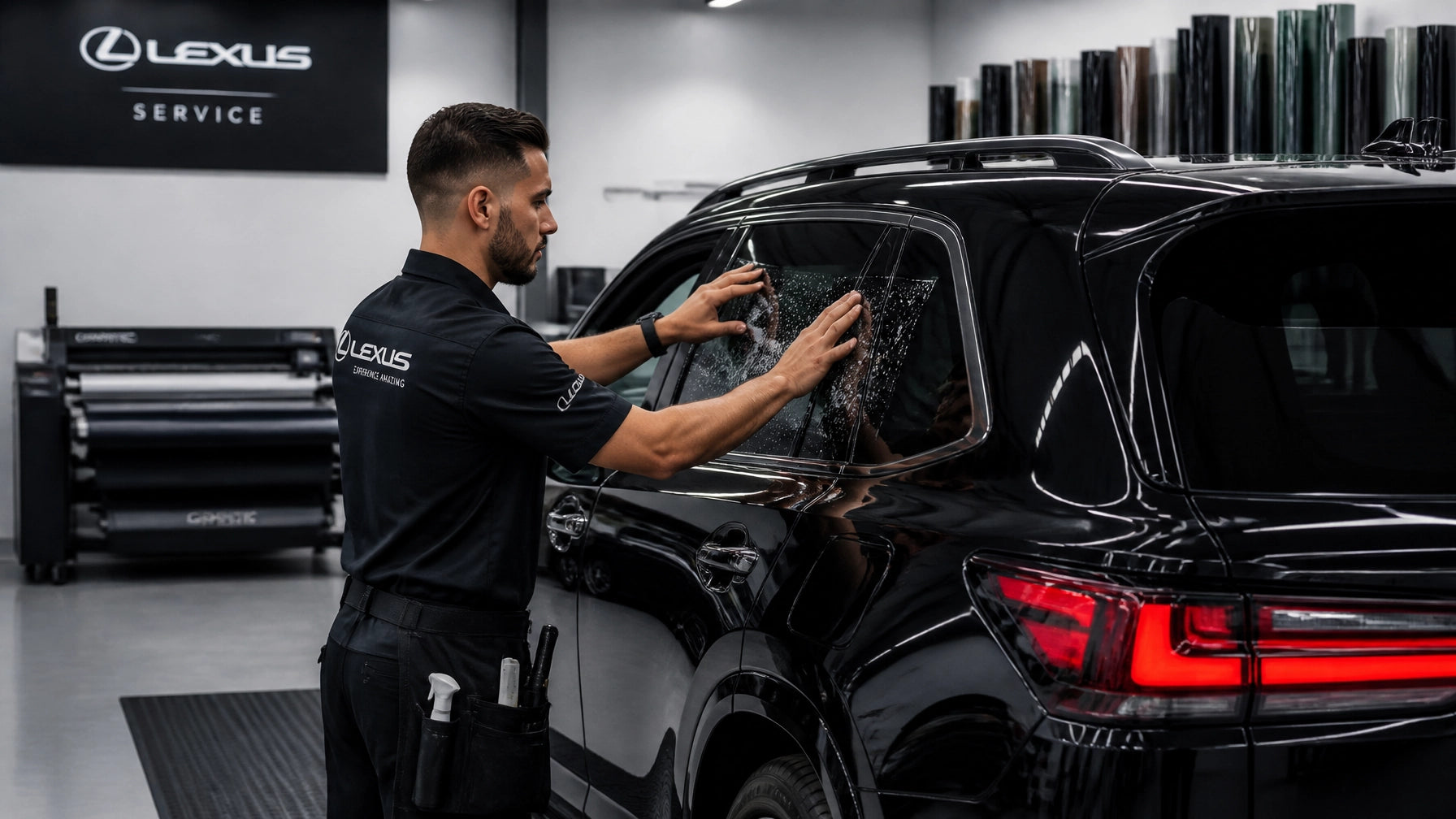
For most automotive dealerships, the math on accessory sales has traditionally been a game of "pass-through" revenue. You sell the tint, you call a local mobile tinter, they do the work in your wash bay, and you take a small cut while they take the lion's share of the profit.
But as margins on new vehicle sales continue to compress, "good enough" is no longer a viable business strategy. Forward-thinking dealer groups across Canada and the USA are realizing that they are sitting on a goldmine: their own service bays.
Bringing your window tint and Paint Protection Film (PPF) services in-house isn't just about saving a few bucks on a vendor invoice; it’s about professionalizing a high-margin department. To do that successfully, you need more than just film: you need automotive window tinting certification that is built for the high-volume dealership environment.
In this guide, we’ll break down why certification is the cornerstone of scaling your in-house operations and how the right training can add $35,000 to $50,000 in monthly revenue to your bottom line.
1. Why Certification is the Foundation of In-House Success
You wouldn't let an uncertified technician rebuild a transmission, yet many dealerships allow uncertified staff to handle window tinting: a service that is highly visible to the customer and has a direct impact on CSI (Customer Satisfaction Index) scores.
Automotive window tinting certification serves three primary purposes in a dealership:
Quality Control and Standardization
Without formal training, installation techniques vary wildly. One tech might use too much water, risking damage to sensitive door electronics, while another might leave gaps or "light gaps" that lead to immediate customer complaints. A certified program, like those offered by Tint Academy, standardizes the process so every vehicle: from a Ford F-150 to a Mercedes-Benz S-Class: is finished to the same factory-grade standard.
Efficiency and Throughput
In a dealership, time is money. A hobbyist might take four hours to tint a vehicle. A certified professional, trained in production-ready workflows, can often complete a full four-door sedan in 90 minutes or less without sacrificing quality. This speed is what allows you to scale and handle the volume of a busy Saturday morning without backing up the shop.
Reduction in "Re-dos" and Film Waste
Film is a consumable cost. Uncertified installers often waste 20-30% of their material due to improper cutting or "creasing" during the heat-shrink process. Professional window tint training teaches your staff how to maximize every roll, significantly lowering your overhead.

2. The ROI: Turning a Service Bay into a Profit Center
The financial case for dealership in-house window tinting is staggering. Let’s look at the numbers.
Most dealerships outsource their tinting for roughly $200–$250 per car, then sell it to the customer for $400–$500. After the vendor is paid, the dealer keeps $150–$250.
When you bring that service in-house with a certified team:
- Film & Consumables Cost: ~$35–$50 per vehicle.
- Labor Cost: ~$40–$60 (internal hourly rate).
- Gross Profit: ~$300–$400 per vehicle.
By simply capturing that extra $150–$200 per car and increasing your volume through better F&I integration, most dealerships see a $35,000 to $50,000 monthly revenue increase. Over a year, that is $400,000 to $600,000 in pure margin that previously left your building.
3. Scaling Beyond Tint: The Power of PPF
While window tint is the "bread and butter" of accessory sales, Paint Protection Film (PPF) is the "steak."
A PPF installation course provides your staff with the skills to protect high-impact areas like hoods, fenders, and mirrors. Because PPF is a more technical install with a higher perceived value, the margins are even greater. A standard front-end PPF package can easily retail for $1,500+, with material costs staying relatively low.
At Tint Academy, we understand that the biggest barrier to in-housing PPF is the upfront cost of equipment. That’s why our dealership training packages include a complete Scorpion Films PPF setup: including a high-speed plotter, cutting software, and all necessary tools: at no extra cost. This allows you to start generating high-margin revenue from day one after training.

4. On-Site Training vs. Off-Site Schools
When choosing a window tint training partner, the location of the training matters as much as the content. Sending your staff away to a school for a week is expensive and disruptive. More importantly, they learn in a "sterile" environment that doesn't mimic the reality of your dealership.
The Tint Academy Advantage: On-Site Dealership Training
We believe that the best place to learn is in the environment where the work will actually happen. Our certified instructors come directly to your dealership. This allows us to:
- Train on real inventory: Your staff learns on the specific makes and models you sell.
- Optimize your workflow: We help you set up your bay, light the area correctly, and integrate the plotter into your local network.
- Minimize Downtime: Your staff stays on-site, and you don't lose them to travel time.
Our focus is on production-ready skills. We don't just teach the "art" of tinting; we teach the "manufacturing" of a tinted vehicle. We focus on standardized installation processes that reduce re-dos and ensure every vehicle is ready for delivery on time.
5. Integrating Tint and PPF into Your Workflow
Getting certified is step one. Step two is integrating these services into your dealership's sales flow.
The F&I Connection
Certified window tinting should be a standard menu item in your F&I office. Because your staff is certified, your F&I managers can sell the service with more confidence, backed by a professional warranty.
The Service Drive Upsell
Your service advisors are your front-line sales team. When a customer brings a car in for an oil change, a certified tint department allows you to offer "same-day" tinting as an upsell. This is only possible when you have trained, in-house staff who can jump on a job immediately.
Pre-Loading Inventory
Many successful dealer groups "pre-load" their inventory with tint and PPF. By doing this in-house, you add thousands of dollars in value to the vehicle at a fraction of the cost of outsourcing, giving you more room to negotiate or higher front-end gross.

6. How to Get Started with Certification
If you are ready to reclaim your margins and professionalize your accessory department, the path is simple:
- Audit Your Current Spend: Look at what you paid outside vendors for tint and PPF over the last 12 months. That number is your starting ROI.
- Select Your Team: Identify 2-3 staff members (often from your detail or recon department) who have a high attention to detail.
- Schedule On-Site Training: Reach out to a provider like Tint Academy that specializes in dealership volume work.
- Implement the Tools: Set up your Scorpion Films plotter and software.
- Go Live: Start with pre-loading a few units of inventory to build confidence, then move to customer-pay work.
Conclusion: The Future of Dealership Profitability
The "outsourcing model" for window tint and PPF is a relic of the past. It creates delays, reduces quality control, and: most importantly: leaves hundreds of thousands of dollars on the table every year.
By investing in automotive window tinting certification and paint protection film training, you aren't just adding a new service; you are building a resilient, high-margin profit center that is entirely under your control.
At Tint Academy, we have helped hundreds of dealerships across North America make this transition. From the first piece of film to the final software calibration, we provide the tools, the training, and the certification you need to scale.
Ready to boost your monthly revenue by $35K+?
Contact us today at Tint Academy to schedule your on-site dealership training and take the first step toward reclaiming your margins.

Share and get 15% off!
Simply share this product on one of the following social networks and you will unlock 15% off!