


If you're thinking about learning Paintless Dent Repair (PDR), one of the first questions you'll probably ask is:
“What PDR tools do I actually need to get started?”
The good news is that you don't need to own every specialized PDR tool on the market before you begin learning.
At PDR Academy and Tint Academy, we believe beginners should first understand the core tools, learn what each tool does and develop proper technique before spending thousands of dollars building a massive collection.

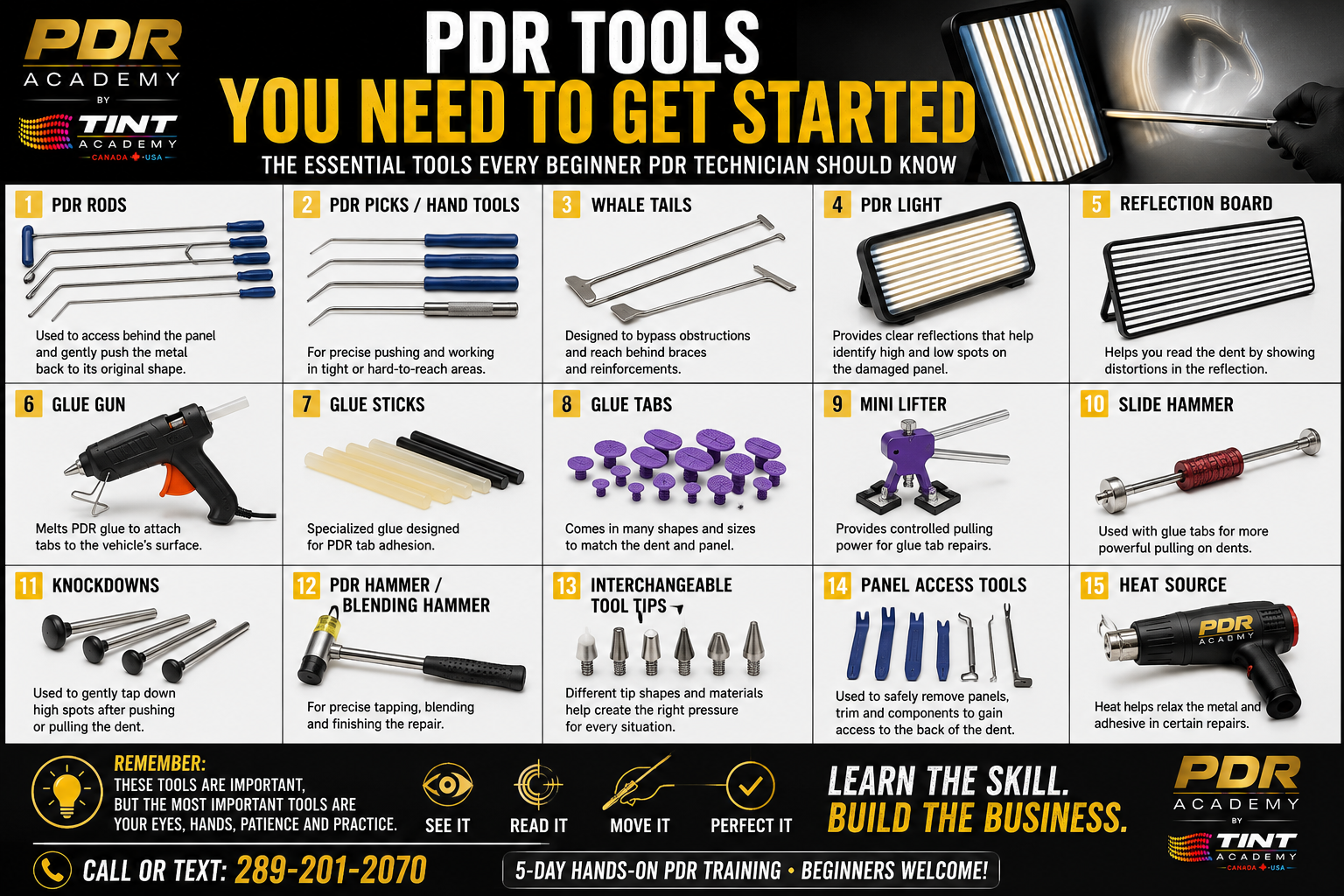
Here's a breakdown of the essential equipment you'll encounter when learning PDR.
1. PDR Rods
PDR rods are among the most recognizable tools in Paintless Dent Repair.
They're used to access the backside of a damaged panel so the technician can apply controlled pressure to specific areas of the dent.
PDR rods come in different:
-
Lengths
-
Diameters
-
Angles
-
Tip configurations
-
Levels of rigidity
The important skill isn't simply owning the rod.
It's developing the ability to know exactly where your tool tip is behind the panel.
That takes practice.
2. PDR Picks and Hand Tools
Smaller picks and hand tools give technicians more options when working in tighter areas or when precise movements are required.
As your experience increases, you'll begin understanding why one tool may work better than another depending on the dent, panel and available access.
Beginners don't need hundreds of tools.
Start with a versatile core selection and expand as your skills develop.
3. Whale Tails
Whale-tail tools are designed to reach behind braces and other areas where conventional rods may have difficulty accessing the damage.
Automotive panels aren't completely open underneath.
Doors, hoods and other panels contain reinforcement structures.
Learning how to safely work around those structures is an important part of becoming a PDR technician.
4. PDR Light
A PDR light is one of the most important pieces of equipment you'll own.
Why?
Because before you can repair a dent, you need to be able to see what the metal is doing.
PDR lights create controlled reflections across the vehicle's surface.
Those reflections help technicians identify:
-
High spots
-
Low spots
-
Crowns
-
Tool-tip position
-
Distortion
-
Progress during the repair
Beginners often think PDR is primarily about learning how to push metal.
A huge part of PDR is actually learning how to see the dent correctly.
5. Reflection Boards
Reflection boards provide another way of reading the shape and movement of a damaged panel.
Lines or patterns reflected across the paint become distorted around the dent.
As the technician manipulates the metal, those patterns change.
Over time, you learn to interpret those changes.
Think of the reflection as your visual roadmap for the repair.
6. Glue-Pulling Equipment
Sometimes you can't conveniently access the backside of a dent.
That's where glue pulling can become valuable.
A basic glue-pulling setup may include:
-
Glue gun
-
PDR glue
-
Different-size glue tabs
-
Mini lifter
-
Slide hammer
-
Release solution
-
Tab-removal tools
A tab is attached to suitable paint using specialized adhesive and then controlled pulling force is applied.
Glue pulling is another skill that requires proper technique and judgment, including assessing paint condition and previous refinishing before use.
7. Mini Lifter
A mini lifter allows technicians to apply controlled pulling force to a glue tab.
Rather than simply yanking on the panel, the technician can make more deliberate adjustments.
You'll learn when to use a mini lifter versus other pulling techniques as your experience develops.
8. Slide Hammer
A PDR slide hammer can provide stronger pulling action than a mini lifter.
It can be useful in specific glue-pulling situations, but more force isn't automatically better.
One of the biggest lessons in PDR is:
CONTROL > FORCE
The goal isn't to pull as hard as possible.
The goal is to move the metal intentionally.
9. Knockdowns
When you push or pull metal, you can create high spots.
Knockdowns allow technicians to carefully tap those areas down and refine the panel.
They come in different materials, shapes and tip styles.
Learning PDR means understanding both sides of metal movement:
Push the lows.
Control the highs.
10. PDR Hammer and Blending Hammer
PDR hammers are used for controlled tapping, knocking down high spots and blending areas of the repair.
Experienced technicians can make extremely precise movements.
To someone watching, the movements may appear small.
But under a PDR light, those tiny adjustments can make a significant difference.
11. Interchangeable Tool Tips
Many PDR tools accept interchangeable tips.
Different tips can change how pressure is transferred into the panel.
Some provide more concentrated pressure while others spread the force over a larger area.
As you progress, you'll learn to choose tips based on:
Dent type + panel + repair stage + desired metal movement.
12. Panel-Access Tools
Getting behind a dent is often part of the challenge.
Depending on the vehicle and repair, technicians may need appropriate tools for safely accessing or removing certain trim and components.
This can include basic trim-removal and hand tools.
Proper access matters because you don't want to create additional damage while attempting to repair the original dent.
13. Heat Source
Controlled heat can play an important role in certain PDR repairs, particularly when managing paint and panel conditions.
However, excessive heat can damage a vehicle.
This is another reason beginners should learn proper technique rather than simply buying equipment and experimenting on customer vehicles.
How Much Should You Spend on Your First PDR Tool Kit?
It's easy to go online and see professional technicians with enormous tool collections and assume you need everything immediately.
You don't.
A better progression is:
STEP 1 — Get trained
Learn what the tools actually do.
STEP 2 — Build a core kit
Buy versatile equipment that covers common practice situations.
STEP 3 — Practice
Discover which tools you naturally use most frequently.
STEP 4 — Expand
Add specialized tools when your work actually requires them.
A professional technician may eventually invest heavily in tools, lighting, glue systems and mobile equipment.
But your first investment should be education and practice—not simply buying the biggest tool cart.
The Most Important PDR Tool Isn't in Your Toolbox
You can buy the same rods, lights and glue systems used by experienced technicians.
That doesn't mean you'll produce the same repair.
The most important tools are ultimately:
Your eyes. Your hands. Your patience. Your experience.
You need to learn how to read reflections.
You need to develop hand-eye coordination.
You need to understand how metal moves.
You need to know where your tool tip is.
You need to recognize when you're making the repair better—and when you're making it worse.
Those skills come from instruction followed by repetition.
Learn How to Use PDR Tools With PDR Academy & Tint Academy
Our 5-Day Hands-On Paintless Dent Repair Training is designed to introduce beginners to the tools and fundamental techniques used in PDR.
Students can learn areas including:
🔨 PDR rods and tool selection
💡 PDR lighting and reflections
🎯 Tool-tip control
🚗 Dent assessment
🛠️ Push techniques
🟣 Glue-pulling fundamentals
🔨 Knockdowns and finishing
🚘 Panel access
👀 Reading highs and lows
📈 Developing a repeatable repair process
No previous PDR experience is required to begin.
PDR Academy and Tint Academy offer training opportunities in Canada, including:
📍 Niagara Falls
📍 Toronto
📍 Edmonton
📍 Vancouver
Start With the Skill—Then Build the Toolbox
Don't make the mistake of thinking that buying expensive tools automatically creates a successful PDR technician.
Tools make the repair possible.
Training teaches you how to use them.
Practice develops the technician.
If you're ready to learn Paintless Dent Repair, start by learning the fundamentals correctly.
🔨 PDR Academy × Tint Academy
📲 Canada: Call or Text 289-201-2070
LEARN THE SKILL. PRACTICE THE SKILL. BUILD THE BUSINESS.
Specific equipment requirements vary by repair, vehicle, training method and technician preference. Beginners should receive appropriate instruction before attempting repairs on customer vehicles.

Share and get 15% off!
Simply share this product on one of the following social networks and you will unlock 15% off!