


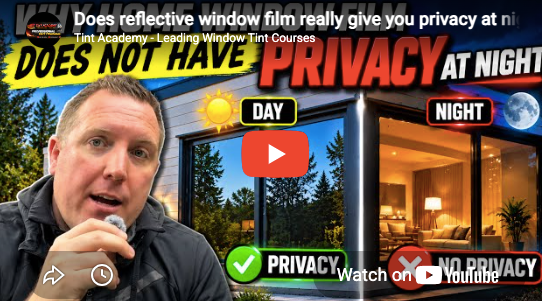
Why Reflective Window Film Doesn't Provide Privacy at Night: The Science Behind Home and Office Window Tinting
Learn why one-way mirror window film works during the day but not at night, the science behind reflective window tint, and the best privacy window film solutions for residential and commercial properties.
Window tinting has become an increasingly popular solution for homeowners and business owners looking to improve privacy, reduce heat, block harmful UV rays, and make their buildings more energy efficient.
But there's one question we hear all the time at Tint Academy:
"Why can people still see inside my house at night when I have reflective window film installed?"
The answer comes down to science, specifically how light travels through glass, how reflective window film works, and the difference in lighting conditions between the inside and outside of a building.
In this article, we'll explain why reflective window film doesn't guarantee nighttime privacy, which types of window films work best for homes and offices, and how professional window tint training can help installers recommend the right products.
🎥 WATCH OUR VIDEO: Why Window Film Doesn't Give You Privacy at Night
https://www.youtube.com/watch?v=XxKRgMS_ysw
How Does Reflective Window Film Work?
Reflective window film, sometimes called one-way mirror window film, is designed to reflect a portion of visible light while allowing another portion to pass through the glass.
These films typically contain reflective coatings that change how much light is reflected, absorbed, and transmitted.
The key scientific principle is that reflective window film does not create a true one-way mirror.
Instead, its apparent privacy depends heavily on the lighting conditions on either side of the window.
The Science of Light Reflection and Transmission
When light reaches a window with reflective film, three things happen:
-
Reflection: Some of the light bounces off the glass and film.
-
Absorption: Some light energy is absorbed by the glass and film.
-
Transmission: Some light passes through the glass and film.
The balance between these properties determines how a window looks and performs.
One important measurement is Visible Light Transmission (VLT).
VLT represents the percentage of visible light passing through the glass and film system.
For example:
-
70% VLT allows approximately 70% of visible light to pass through.
-
35% VLT allows approximately 35% of visible light to pass through.
-
15% VLT allows approximately 15% of visible light to pass through.
Lower VLT generally creates a darker appearance, but darker window film does not automatically mean complete privacy.
Why Does Reflective Window Tint Provide Privacy During the Day?
During daylight hours, the exterior of a home or office is usually much brighter than the interior.
Sunlight hits the reflective window film, producing a visible reflection on the outside surface.
This reflection makes it more difficult for people outside to see through the glass.
For example, someone walking past a residential window during the day may see reflections of trees, the sky, and surrounding buildings rather than clearly seeing the room inside.
This is why reflective window film is popular for:
-
Residential homes and condominiums
-
Commercial office buildings
-
Storefronts and retail spaces
-
Ground-floor windows
-
Buildings with large glass surfaces
However, this privacy effect depends on the relative brightness inside and outside.
Why Can People See Through Reflective Window Film at Night?
Here's where the science becomes especially important.
At night, the lighting conditions often reverse.
Outside, it becomes dark. Inside, homeowners and office workers turn on their lights.
Now the interior is brighter than the exterior.
Because reflective window film still allows some visible light to pass through, people standing outside may be able to see into the illuminated room.
At the same time, occupants inside may see strong reflections of their own room on the glass.
The window film hasn't stopped working. The lighting conditions have changed.
Does One-Way Mirror Window Film Work at Night?
One-way mirror film does not provide reliable nighttime privacy when the interior is brightly illuminated and the exterior is dark.
Even highly reflective films can allow visibility into a building under these conditions.
This is an important concept for professional window tint installers to explain before installing residential or commercial privacy film.
A customer expecting complete nighttime privacy may be disappointed if the installer recommends a reflective product without discussing how it performs after sunset.
What Is the Best Window Film for Privacy at Night?
The best privacy solution depends on whether the customer wants to maintain a clear view through the glass.
1. Frosted Window Film — Best for Day and Night Privacy
Frosted window film creates a translucent appearance that obscures clear visibility through glass.
It is an excellent solution for bathrooms, conference rooms, office partitions, entryways, and other areas requiring privacy.
Benefits include:
-
Privacy during both daytime and nighttime
-
Natural light transmission
-
Decorative appearance
-
Suitable for residential and commercial glass
-
Multiple patterns and finishes
Frosted films obscure details rather than creating a reflective one-way mirror effect. Silhouettes may still be visible, particularly when someone is close to the glass or strongly backlit.
2. Reflective Window Film — Best for Daytime Privacy
Reflective window film is ideal for customers who want daytime privacy, glare reduction, solar heat control, and a reflective exterior appearance.
It is especially useful for large windows exposed to significant sunlight.
However, customers must understand that nighttime privacy is not guaranteed.
3. Dual-Reflective Window Film — Best for Daytime Views and Interior Comfort
Dual-reflective window film is designed with different reflective properties on its interior and exterior surfaces.
Many products have a more reflective exterior and a less reflective interior to reduce distracting interior reflections at night.
These films are popular for residential and commercial applications where maintaining the view is important.
However, dual-reflective film does not eliminate nighttime visibility from outside when interior lighting is brighter.
4. Opaque Privacy Film — Best for Maximum Visual Privacy
Opaque films block the view through treated glass.
They are suitable for locations where privacy is more important than maintaining visibility or natural light.
Common applications include storage areas, private offices, and glass partitions.
5. Window Film Combined With Blinds or Curtains
For homeowners who want daytime privacy without sacrificing their exterior view, reflective solar control film combined with blinds, curtains, or shades is often the most practical solution.
The window film provides daytime benefits, while the window covering provides additional privacy after dark.
Reflective vs. Frosted vs. Dual-Reflective Window Film
| Window Film Type | Daytime Privacy | Nighttime Privacy | Clear Exterior View |
|---|---|---|---|
| Reflective | Good with favorable lighting | Not guaranteed | Yes |
| Dual-reflective | Good with favorable lighting | Not guaranteed | Yes |
| Frosted | Good visual obscuration | Good visual obscuration | No |
| Opaque | High | High | No |
| Solar film + blinds | Good when properly selected | High with blinds closed | Yes when blinds open |
Actual privacy depends on product specifications, lighting, installation, and viewing conditions.
Why Window Film Installers Need to Understand Film Science
At Tint Academy, we believe professional window tinting involves more than learning how to install film.
A successful installer must understand how window film performs and how to recommend the right solution for each customer.
Residential and commercial clients may have different priorities.
Some want to reduce solar heat. Others want UV protection, glare control, decorative privacy, or improved comfort.
Understanding the differences between reflective, non-reflective, frosted, and solar control window films helps installers avoid incorrect product recommendations.
It also creates opportunities to offer customers more valuable solutions.
Why Automotive Window Tinters Should Consider Flat Glass Window Tinting
If you're already installing automotive window tint, residential and commercial window film can be a valuable additional service.
Flat glass window tinting creates opportunities to work with homeowners, offices, retail businesses, commercial buildings, and property managers.
Unlike automotive installations, architectural window film requires additional knowledge about glass types, thermal stress, film-to-glass compatibility, solar performance, and installation methods.
Not every automotive film is appropriate for architectural glass.
Learning these differences is essential before entering the residential and commercial window film market.
Learn Window Tinting With Tint Academy — Hands-On Certification Courses
Whether you're starting a new window tinting business, expanding your detailing shop, or looking to add residential and commercial window film services, Tint Academy offers hands-on window tint certification training.
With more than 6,500 students trained worldwide, Tint Academy focuses on real-world skills, professional installation techniques, and helping students develop confidence working with window film.
Our training opportunities include:
-
Automotive Window Tint Certification
-
Paint Protection Film (PPF) Certification
-
Residential and Commercial Flat Glass Training
-
Safety and Security Window Film Training
Upcoming Window Tint Certification Courses — Fall 2026
Canada
🇨🇦 Toronto, Ontario — October 31 & November 1
🇨🇦 Edmonton, Alberta — November 7–8
🇨🇦 Halifax, Nova Scotia — November 14–15
🇨🇦 Calgary, Alberta — November 21–22
🇨🇦 Winnipeg, Manitoba — November 28–29
United States
🇺🇸 Nashville, Tennessee — October 31 & November 1
🇺🇸 Orlando, Florida — November 7–8
🇺🇸 New York City, New York — November 7–8
🇺🇸 Dallas/Fort Worth, Texas — November 14–15
🇺🇸 Phoenix, Arizona — November 14–15
*Dates above are automotive window tint courses. Contact Tint Academy for dedicated flat glass and architectural

Share and get 15% off!
Simply share this product on one of the following social networks and you will unlock 15% off!