


For a modern dealership, window tint and paint protection film (PPF) are more than optional accessories. They are high-margin services that can increase revenue per vehicle, improve customer satisfaction, and reduce dependence on outside vendors.
But adding film services successfully requires more than purchasing rolls of film and handing a squeegee to an available technician. Dealerships need a documented standard, production-ready skills, and a team that can deliver consistent results across a high volume of vehicles.
That is why automotive window tinting certification has become the gold standard.
Certification may not be a government-issued license in every province or state. However, for serious dealerships, it is effectively mandatory. It protects your reputation, reduces re-dos, supports compliance, and gives your team the skills required to turn tint and PPF into a dependable profit centre.
Why Certification Is Mandatory for Dealership Operations
Dealerships operate under a different standard than independent installers. Every vehicle represents your brand, your customer experience, and your financial responsibility.
An inconsistent tint installation can lead to:
- Customer complaints and poor CSI results
- Re-tinting and warranty costs
- Delayed vehicle deliveries
- Damage to glass, trim, electronics, or paint
- Compliance concerns related to visible light transmission
- Lost confidence from sales, service, and management teams
In a dealership environment, one poor installation can affect far more than one job. It can create a comeback, interrupt production, occupy a service bay, and damage the customer’s perception of the entire dealership.
Certification establishes a clear expectation: technicians must understand the correct preparation, installation, inspection, and quality-control processes before working on customer vehicles.
It also creates accountability. Instead of relying on individual habits or trial and error, your team follows a repeatable system.
The Risks of Uncertified Window Tint Work
Uncertified work often looks acceptable from a distance but fails under close inspection. Common problems include contamination, fingers, bubbling, peeling edges, uneven shrinkage, visible gaps, and scratches caused by improper tools or preparation.
These problems are especially costly when dealerships are processing new vehicles under time pressure.
Compliance and VLT Risk
Window tint laws vary by province and state. Requirements can also differ according to vehicle type, window position, and whether the glass is factory-installed or modified with aftermarket film.
In the United States, FMVSS No. 205 addresses glazing materials and light transmittance. NHTSA guidance explains that businesses, including dealers and repair facilities, must not modify covered glazing in a way that reduces required visibility below federal standards.
In Canada, provincial rules govern aftermarket tint and inspection requirements. For example, Ontario places strict limits on tint applied to the windshield and front side windows. Dealership teams must understand the difference between factory glass, combined VLT, permitted areas, and customer requests that may not be legal for road use.
Certification does not replace local legal advice or compliance procedures. It ensures your technicians are trained to recognize these issues, measure final results, and follow a professional process before vehicle delivery.
Warranty and Reputation Risk
Film manufacturers and customers expect installations to be completed according to product requirements. If a technician skips proper cleaning, uses incorrect heat, overstretches film, or creates edge failures, the dealership may be responsible for the resulting warranty claim.
Uncertified work also makes it difficult to identify where a process failed. A certified team, by contrast, has documented methods for preparation, installation, inspection, and correction.
Certification Creates Standardized Processes
The biggest difference between casual installation and dealership-level production is consistency.
A dealership may have several technicians working on different vehicle brands, body styles, and window designs. Without a standardized process, each technician may use different techniques, tools, or quality standards.
A professional certification program creates one operating system for the department.
At Tint Academy, training covers practical skills such as:
- Vehicle and glass preparation
- Film handling and positioning
- Hand-cutting and plotter-cutting methods
- Shrinking curved rear windows
- Installing film on sedans, trucks, SUVs, and frameless windows
- Safe removal of old film
- Contamination control
- Edge finishing and inspection
- Efficient workflow for production environments
- Troubleshooting common installation issues

These processes reduce variation between technicians and make it easier for management to monitor quality. When the same system is used on every vehicle, re-dos decrease, cycle times become more predictable, and the department can confidently accept more work.
Why PPF Requires Professional Training
Paint protection film is a high-value service, but it is also technically demanding. A poor PPF installation can result in lifting edges, trapped contamination, stretch marks, distorted patterns, exposed paint, or damage during removal.
A proper PPF installation course teaches technicians how to work with the material and the vehicle as a complete system.
Professional PPF training includes:
- Surface preparation and decontamination
- Slip and tack solution setup
- Pre-cut pattern installation
- Bulk film installation
- Film control and stretching
- Edge wrapping
- Hood, bumper, mirror, fender, and door-cup installation
- Pattern adjustment and troubleshooting
- Workflow and pricing for dealership packages
PPF installation is not simply a matter of placing film on paint. It requires judgment, controlled movement, efficient positioning, and an understanding of how the film behaves on complex panels.
For dealerships selling premium protection packages, professional PPF training is essential. It helps ensure that the product sold by the sales team can be delivered by the service department at the expected quality level.

The Tint Academy Difference
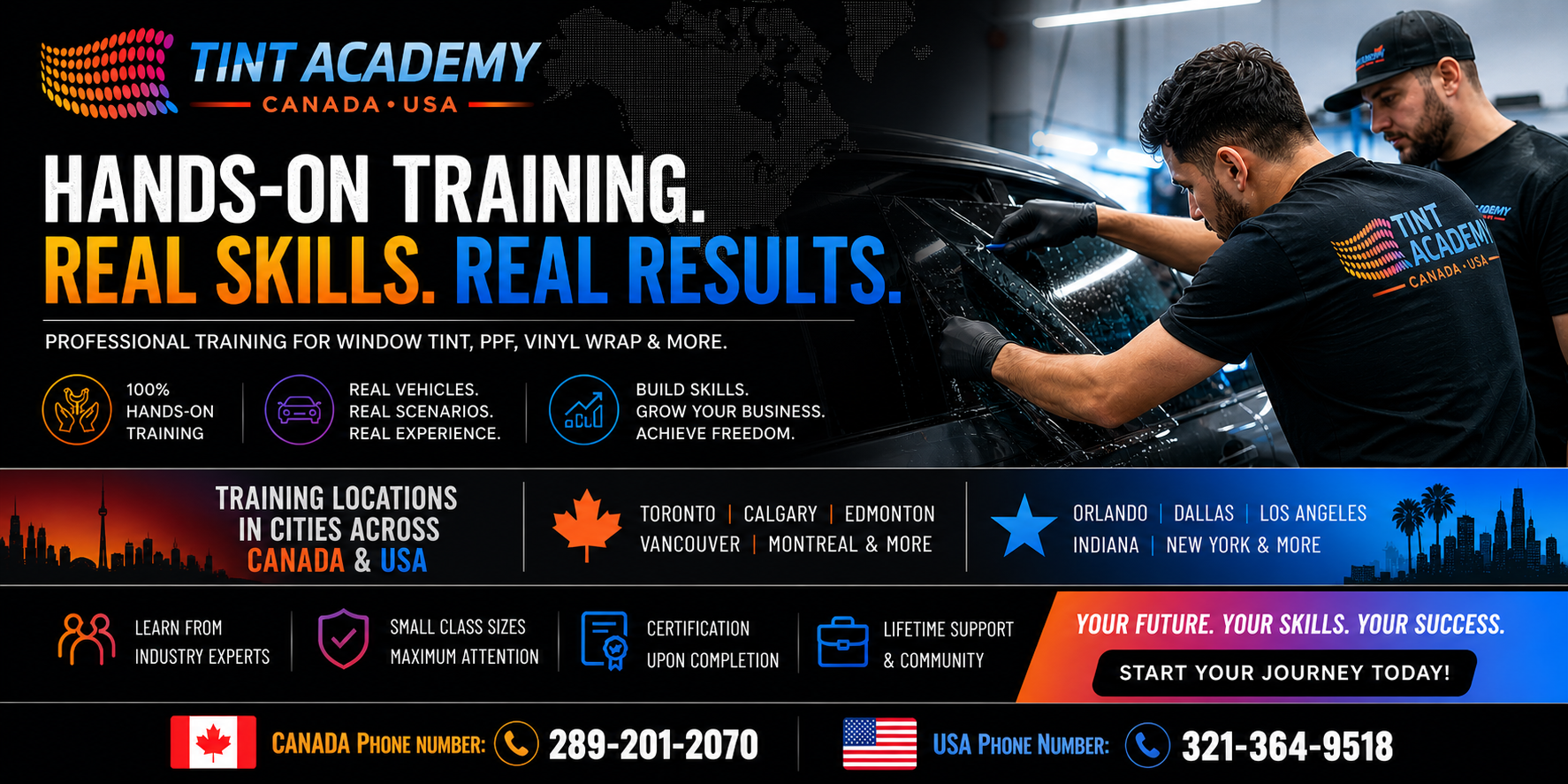
Tint Academy is positioned as the leading window tint and PPF training provider for professionals across Canada and the USA.
The difference is the focus on real-world installation: not classroom theory alone.
Tint Academy training is designed around:
- Hands-on work with real vehicles
- Certified instructors with practical industry experience
- Small-group coaching and direct feedback
- Production-ready installation methods
- Standardized workflows for volume work
- Both window tint training and PPF installation training
- Business, pricing, and operational guidance
- Continued support after certification
Our window tint certification course teaches technicians how to install film on the vehicle types dealerships work with every day. Training is available across multiple locations in Canada and the USA, with private and dealership-focused options available.
For dealerships comparing the best window tint training in Canada or the best window tint training in the USA, the important question is not simply where a certificate comes from. The question is whether the training prepares your team to work efficiently, safely, and consistently in a real dealership environment.
A Complete PPF Setup Included
Training is only one part of launching an in-house PPF department. Dealerships also need the right equipment and software to produce accurate patterns efficiently.
That is why Tint Academy dealership training includes a complete PPF setup from Scorpion Films at no extra cost. The package includes:
- Professional plotter
- Scorpion pattern software
- Starter tools
- Peel board
- Equipment needed to begin building a production workflow
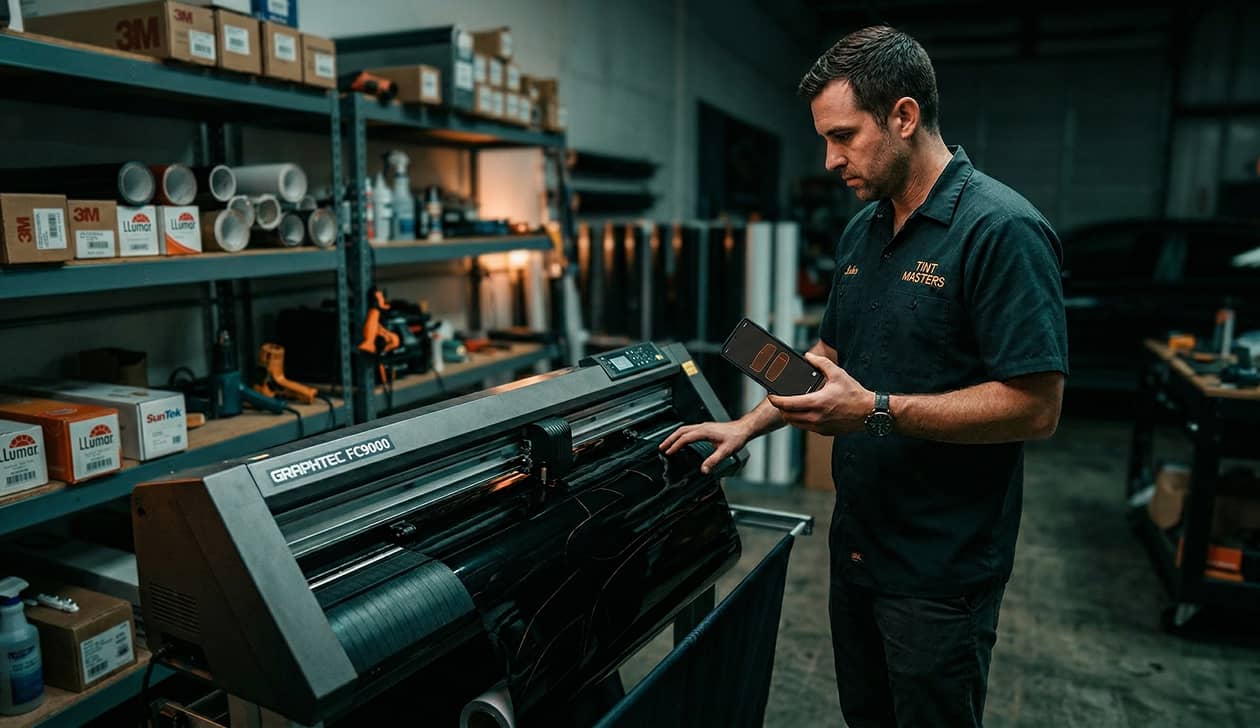
Scorpion’s software is built for repeatable cutting and supports thousands of window and PPF patterns. Its pattern systems are designed to reduce material waste, improve fit, and minimize rework.
The combination of certification, equipment, and software gives dealerships a practical path to launching an in-house operation without trying to assemble a system from disconnected vendors.
The ROI of Certified In-House Installation
The financial case for certification is straightforward.
When a dealership outsources tint and PPF, it gives away margin, loses control over scheduling, and depends on another company to represent its customer experience.
When the work is brought in-house with properly trained staff, the dealership can:
- Capture more profit per vehicle
- Reduce outsourcing expenses
- Add premium accessories during the sales and F&I process
- Improve delivery timelines
- Control quality from start to finish
- Reduce re-dos and warranty work
- Build a repeatable department that scales with volume
Most dealerships working with Tint Academy see $35,000–$50,000 or more in monthly revenue increases after training, depending on vehicle volume, package pricing, sales execution, and departmental capacity.
Certification is what makes that opportunity operationally realistic. Without trained technicians and standardized processes, additional sales can create a backlog of unfinished work. With the right training, every additional sale can become a controlled, profitable production opportunity.
Tint and PPF Certification Is a Business Standard
The strongest dealerships do not treat tint and PPF as side work. They treat them as professional service departments with defined procedures, trained personnel, quality checks, and measurable results.
That is the real meaning of tint and PPF certification.
It demonstrates that your dealership is prepared to protect customer vehicles, follow appropriate installation practices, and deliver a consistent experience across every job. It also gives owners and general managers greater confidence when investing in equipment, staffing, and accessory sales programs.
Whether you operate a single franchise location, a dealer group, an auto mall, or a high-volume service department, certification should be the first step: not an afterthought.
Enroll Your Dealership with Tint Academy
If your dealership is ready to bring window tint and PPF in-house, Tint Academy provides the training, processes, tools, and support needed to begin with confidence.
Explore the Tint Academy dealership training program, review our window tint and PPF certification courses, or contact Tint Academy to discuss your dealership’s goals.
Certification is not merely a credential. It is the operating standard that protects your reputation, reduces re-dos, improves efficiency, and turns automotive film services into a scalable source of dealership revenue.
Train your team. Standardize your process. Build your in-house profit centre with Tint Academy.

Share and get 15% off!
Simply share this product on one of the following social networks and you will unlock 15% off!