


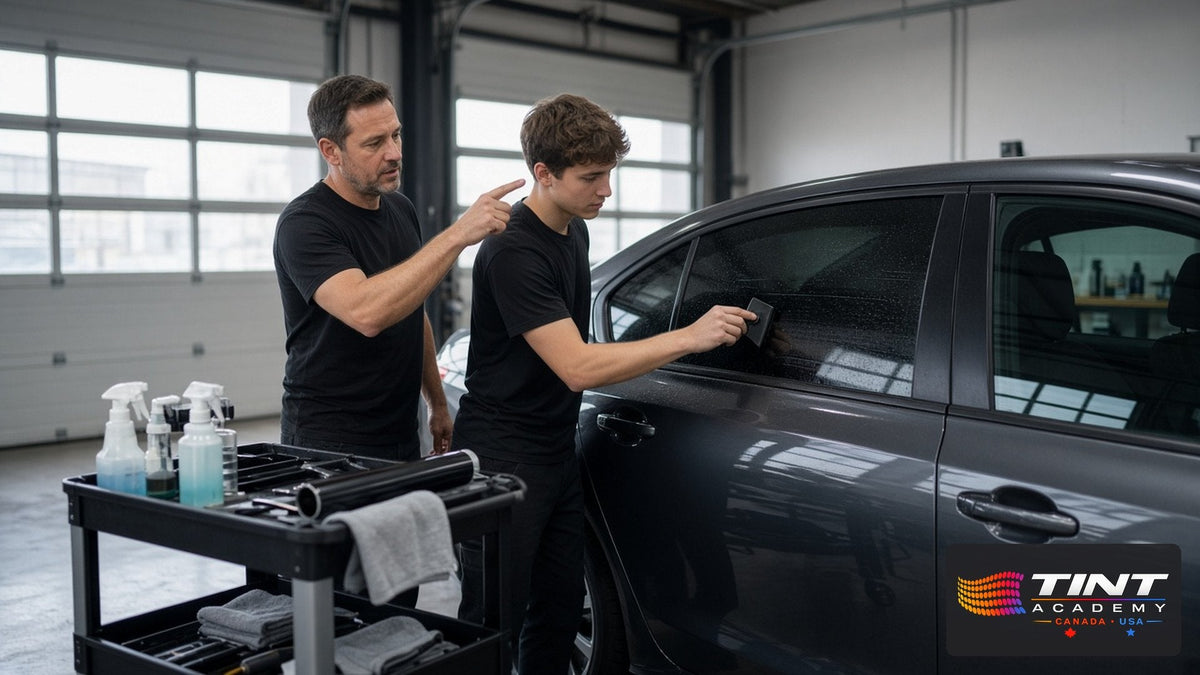
Quick answer: To become a certified window tinter in Canada or the USA, (1) learn the fundamentals, (2) take a hands-on window tint course on real vehicles, (3) earn a window tint certification, (4) practice until your installs are clean and repeatable, (5) learn your local tint laws, and (6) set up your business and start booking customers. There is no specific government licence to tint windows in most places, but you do need the skill, the right tools and a legal business setup.
Window tinting is a practical trade that rewards patience and good technique. Whether you want a side hustle, a mobile tint business, or an extra service for your detailing or wrap shop, this guide walks through each step — what to learn, what certification actually means, what it costs and how to land your first customers. It is written by Tint Academy, which has trained more than 6,500 students over 10 years in cities across Canada and the USA.
What Does a Window Tinter Do?
An automotive window tinter installs thin film on the inside of vehicle glass to reduce heat, glare and UV, and to add privacy. A typical job includes:
- Explaining film options and legal darkness limits to the customer
- Cleaning and preparing the glass and door seals
- Measuring and cutting the film (by hand or with a plotter)
- Heat shrinking film to fit curved rear windows
- Installing the film with slip solution and squeegees
- Finishing edges and removing old, failed tint
Many tinters also install residential or commercial flat-glass film, and a growing number add paint protection film (PPF) as a related service.
Step 1: Learn the Fundamentals
Before you touch a car, understand the basics: the difference between dyed, carbon and ceramic films; what visible light transmission (VLT) means; why contamination causes bubbles and specks; and how heat shrinking works. Videos and an online course are a good, low-cost way to learn the vocabulary and steps so you get more out of hands-on training.
Tint Academy’s online window tint certification course is listed at $197 USD for the course and certificate, or $649 with a 60" roll of film and tools. Students who take the in-person class also get access to the online training to review after class.
Step 2: Take a Hands-On Window Tint Course
Tinting is a hand skill. Reading about squeegee pressure is not the same as feeling it on a frameless door glass. The quickest way to get the technique right is to train in person, on real vehicles, with an instructor watching and correcting your mistakes.
The Tint Academy 2-day window tint course runs 9:00 AM to 5:00 PM both days. Day 1 covers theory, tools and film, glass preparation, installation drills, roll-down, quarter and frameless windows, tint removal and sun strips. Day 2 covers heat shrinking, sedan and hatchback rear windows, rear-window tint removal, trucks and SUVs, a plotter overview, an introduction to residential film, and pricing, quoting and marketing.
Classes are held in Canada — Toronto, Niagara Falls, Montreal, Edmonton and Calgary, Winnipeg and Halifax — and in the USA — New York, Orlando, North Charleston, SC, Dallas–Fort Worth, Indiana, Los Angeles and Nashville, with additional dates (including Las Vegas) listed on the main window tint course page.
What to look for in a window tint training course
- Real vehicles, not just flat practice glass
- Small classes so you get individual feedback
- Rear windows and heat shrinking — the hardest part for beginners
- Tools and film you keep, so you can keep practicing at home
- Business, pricing and marketing training
- Support after class: mentors, a community, or the option to come back for more practice
Step 3: Earn Your Window Tint Certification
“Certified window tinter” usually means you completed a training program and received a certificate from the school, a film manufacturer or an industry association. Tint Academy students receive Tint Academy certification when they complete the 2-day class. It shows customers, employers and dealerships that you completed structured, hands-on window tint training.
A training certificate is not a government licence. Some installers later add credentials from film manufacturers’ dealer programs or from the International Window Film Association (IWFA), which offers accreditation testing for individuals, including an Automotive Film Specialist test. For the full breakdown, read Window Tint Certification Explained or see the window tint certification course page.
Step 4: Practice Until Your Installs Are Consistent
Nobody becomes a master installer in two days. After your course, keep practicing — on your own car, friends’ and family vehicles, and scrap glass. Focus on the skills that separate clean work from callbacks:
- Contamination control: clean glass, clean hands, clean solution
- Even, overlapping squeegee strokes
- Tight, consistent edge gaps
- Heat shrinking rear windows without creasing the film
- Working through one problem area at a time
Tint Academy students keep their tool kit and 100 ft roll of ceramic film, so they can practice right away, and they can return to eligible future classes for observation and extra practice.
Step 5: Learn Your Local Window Tint Laws
Every province and state sets its own rules for how dark tint can be on each window, usually expressed as VLT (the percentage of visible light that passes through). Some places restrict tint on the front side windows or windshield, some require a label or receipt, and some allow medical exemptions. As a professional, you are expected to know the rules where you work and explain them to customers. Check your provincial transportation ministry or state statutes before you install.
Step 6: Set Up Your Window Tint Business
Once your work is consistent, decide how you want to operate:
- Mobile tinting: low overhead, but you need a clean, sheltered space at each job
- Shop-based: better control of dust and lighting; higher fixed costs
- Add-on service: detailers, wrap and PPF installers, and auto glass shops can offer tint to customers they already have
- Working with dealerships: steady volume, but expect tight turnaround times
Register your business where required, get appropriate liability insurance, choose a film supplier, and set your prices based on your local market, your costs and the time each vehicle takes you. Tint Academy’s course includes pricing, quoting and marketing training plus supplier access. Your results will depend on your skill, location, pricing and how much work you book — no course can guarantee income.
Step 7: Get Your First Customers
- Set up a Google Business Profile with clear photos of your work
- Post before-and-after photos and short videos on social media
- Ask every happy customer for a review
- Reach out to local detailers, dealerships and car clubs
- Be clear about legal tint limits — it builds trust
How Much Does It Cost to Become a Window Tinter?
The main costs are training, tools, film, and business setup (registration and insurance). Tint Academy’s 2-day course is listed at $1,299 in most cities (regular $1,450), $1,500 in North Charleston, SC, with a deposit option, and it includes a professional tool kit and a 100 ft roll of ceramic film. For a full comparison of course types and hidden costs, read How Much Does Window Tint Training Cost?
Frequently Asked Questions
How long does it take to become a window tinter?
You can learn the full installation process in a 2-day hands-on window tint course, but becoming consistently fast and clean takes ongoing practice after class. Most new tinters keep practicing on their own and friends' vehicles before taking on paying customers.
Do I need a licence to become a window tinter?
In most of Canada and the USA there is no specific government licence just to install automotive window film. You still need to register your business where required, carry appropriate insurance and follow the window tint laws in your province or state.
Can I become a window tinter with no experience?
Yes. Tint Academy's 2-day window tint course requires no previous experience, and many students are complete beginners.
What tools do I need to start window tinting?
At minimum: squeegees and hard cards, a sharp snap-off blade knife, spray bottles, a heat gun, scrapers, lint-free towels and professional window film. Tint Academy students take home a professional tool kit and a 100 ft roll of ceramic window film.
Can I learn window tinting online?
You can learn the theory, tools and steps online — Tint Academy's online window tint certification course is listed at $197 USD. Because tinting is a hands-on skill, an in-person class with instructor feedback on real vehicles is the fastest way to build technique.
Is window tint certification required to get customers?
Customers and dealerships often ask about training and certification, and a certificate shows you completed a structured program. What wins repeat work, however, is clean, consistent installs and good customer service.
Start Your Window Tint Training
Ready to become a certified window tinter? Pick a date on the window tint course and certification page, or browse every location in our Window Tint & PPF Certification Guide. Questions? Call or text our team — Canada: 289-201-2070 or 289-236-5195; USA: 321-364-9518 or 321-334-3596.
Notice: prices and dates in this article are as listed on tintacademy.store on November 2, 2026. The currency and final amount for your country are shown at checkout.

Share and get 15% off!
Simply share this product on one of the following social networks and you will unlock 15% off!