


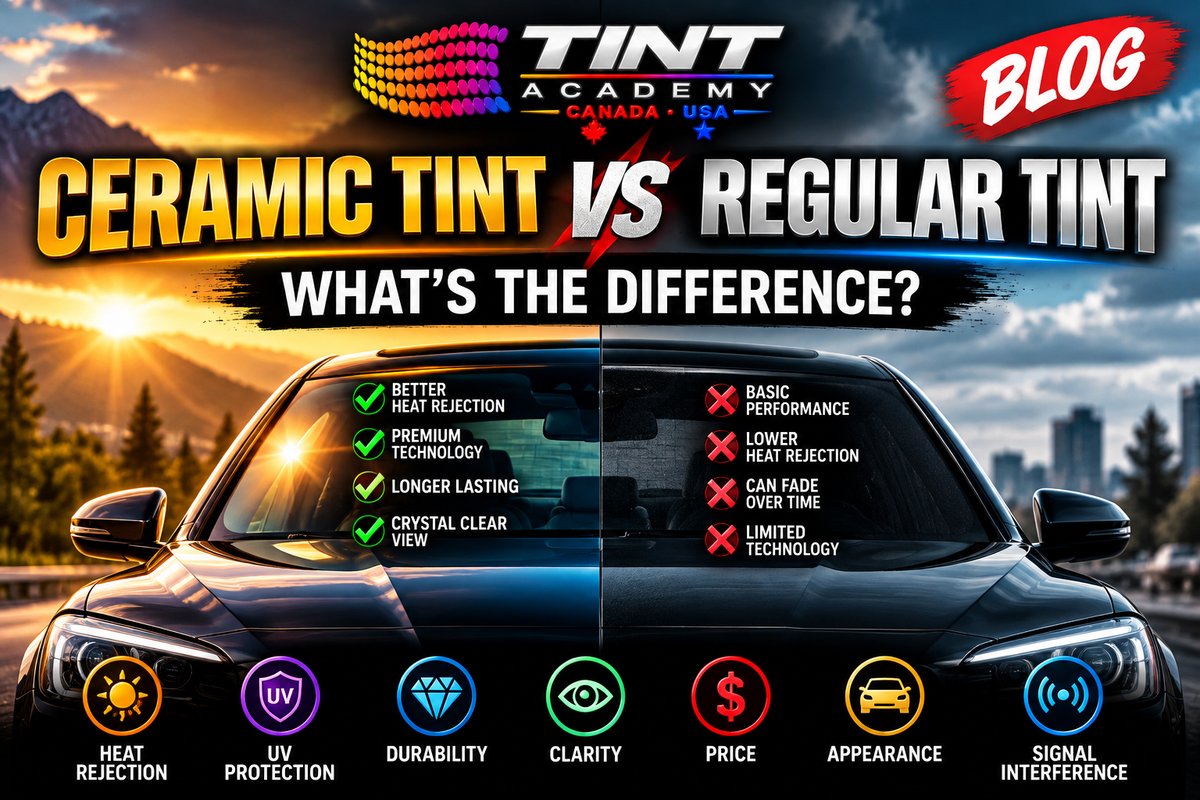
Ceramic Tint vs Regular Tint: What’s the Difference?
If you’re considering window tint for your car, one of the biggest decisions is choosing the type of window film.
You may have heard terms such as ceramic tint, dyed tint, carbon tint, nano-ceramic film, IR rejection and UV protection—but what actually makes one window tint different from another?
And is ceramic window tint worth paying more for?
At Tint Academy, we train window tint installers across Canada and the United States, and understanding the differences between window film technologies is an important part of becoming a knowledgeable installer.
In this guide, we’ll explain ceramic tint vs regular tint, how each type works, their advantages and disadvantages, and what customers and professional installers should know before choosing a film.
What Is Regular Window Tint?
The phrase “regular window tint” isn't one specific type of film.
Consumers often use it to describe traditional or entry-level automotive window films, particularly dyed window film.
Dyed film uses dye within its construction to darken the glass, reduce visible light and improve the appearance and privacy of a vehicle.
Depending on the specific product, traditional films can provide:
- Reduced glare
- Increased privacy
- UV protection
- A darker appearance
- Some solar-energy rejection
- More comfortable driving conditions
However, not every window film performs the same way.
Two films that both appear to be 20% tint can have significantly different performance characteristics.
That distinction becomes especially important when comparing traditional dyed films with modern ceramic films.
What Is Ceramic Window Tint?
Ceramic window tint is a higher-performance automotive window film that incorporates ceramic-based technology rather than relying solely on dye to achieve its performance characteristics.
Modern ceramic films are designed to provide strong solar-performance characteristics while maintaining good optical clarity.
Depending on the manufacturer and product line, ceramic window film may offer enhanced:
Infrared heat rejection
UV protection
Glare reduction
Optical clarity
Color stability
Durability
One important point is that “ceramic” does not automatically mean every ceramic film performs identically.
Film specifications vary significantly between manufacturers and product lines.
Professional installers should compare the actual technical specifications of the films they sell rather than assuming that every product carrying the word ceramic offers the same performance.
Ceramic Tint vs Regular Tint: The Main Differences
The biggest differences generally involve solar performance, construction, durability and price.
| Feature | Ceramic Tint | Traditional/Regular Tint |
|---|---|---|
| Heat rejection | Generally higher-performance options available | Varies considerably |
| UV protection | Typically high | Often high, depending on film |
| Infrared rejection | Often a major selling point | Typically lower on basic films |
| Optical clarity | Generally excellent with quality film | Depends on product quality |
| Color stability | Typically very good | Depends on film construction |
| Signal interference | Generally minimal | Depends on film technology |
| Price | Higher | Usually more affordable |
| Appearance | Premium, clean appearance | Good appearance at lower cost |
| Longevity | Often positioned as premium/long-life film | Product dependent |
Important: Always check the manufacturer's published specifications and warranty. Performance cannot be determined simply by whether a film is labeled “ceramic.”
1. Heat Rejection
One of the biggest reasons customers upgrade to ceramic window tint is heat management.
Vehicles sitting in direct sunlight absorb solar energy through their glass and interior surfaces.
High-performance ceramic films are engineered to reject a portion of that solar energy before it contributes to interior heat buildup.
This can make a noticeable difference in driving comfort, particularly in sunny climates.
However, installers should be careful when discussing heat rejection.
Terms such as:
IR rejection
Total Solar Energy Rejected (TSER)
Visible Light Transmission (VLT)
describe different characteristics.
An extremely high advertised infrared-rejection percentage does not necessarily mean the same thing as total solar-energy rejection.
A knowledgeable installer should understand the specifications instead of simply repeating the biggest number on the box.
2. UV Protection
UV protection is another major reason consumers purchase automotive window film.
Quality window films—including many non-ceramic products—can block a very high percentage of ultraviolet radiation.
This can help reduce UV exposure through treated vehicle glass and may also help slow UV-related fading and deterioration of interior materials.
But this is another area where consumers shouldn't automatically assume:
Ceramic = UV protection
Regular tint = no UV protection
Many quality traditional films also offer excellent UV protection.
Always compare the specifications of the individual product.
3. Infrared Rejection
This is where ceramic window film is heavily marketed.
Infrared radiation represents part of the solar spectrum associated with heat.
Many ceramic films are specifically engineered to improve infrared rejection, commonly referred to in the industry as IR rejection.
That's why a premium ceramic tint can sometimes provide better heat performance than a darker, inexpensive dyed film.
This leads to an important concept:
Darker doesn't automatically mean cooler.
A customer might assume that a 5% film must reject more heat than a lighter 35% or 50% ceramic film simply because it looks darker.
That isn't necessarily true.
Visible Light Transmission and solar-energy performance are different measurements.
What Does VLT Mean in Window Tint?
VLT stands for Visible Light Transmission.
It represents the approximate percentage of visible light that passes through a film/glass system under specified test conditions.
Common tint percentages include:
5% — extremely dark
15% — very dark
20% — dark
35% — medium
50% — light
70% — very light
Lower VLT generally means a darker appearance.
But VLT shouldn't be confused with heat rejection.
A high-performance ceramic film can be relatively light while still offering meaningful solar performance.
This is particularly useful for customers who want heat and UV protection without dramatically darkening their windows, subject to applicable local tint laws.
4. Ceramic Tint Can Provide Excellent Optical Clarity
Another advantage of quality ceramic films is optical clarity.
Cheap or low-quality window films may sometimes exhibit issues such as distortion, haze or undesirable color.
A premium film should provide a clean view through the glass while maintaining its intended appearance.
For professional installers, optical clarity becomes especially important when working on:
- Windshields
- Luxury vehicles
- Large rear windows
- Vehicles with complex glass
- Customers requesting lighter shades
Film quality matters.
But installation quality matters too.
Even premium film can look terrible if it is contaminated, creased, improperly shrunk or poorly installed.
5. Durability and Color Stability
Older or inexpensive window films have historically been associated with problems such as:
Purple discoloration
Bubbling
Adhesive failure
Peeling
Fading
Film technology has improved considerably, and modern professional films can offer much better durability.
Premium ceramic films are generally marketed toward customers looking for long-term performance and color stability.
Again, though, the manufacturer, adhesive system, film construction, installation quality and warranty all matter.
The word ceramic by itself is not a guarantee of quality.
6. Does Ceramic Tint Interfere With Cell Phones or GPS?
Modern ceramic films are generally designed to be non-metallic, so they typically do not create the type of electronic-signal concerns historically associated with some metallized films.
That can matter for vehicles using:
- GPS
- Smartphones
- Bluetooth-connected devices
- Satellite-based systems
- Other wireless technology
This is one reason ceramic technology has become popular in premium automotive window-film applications.
7. Ceramic Tint vs Regular Tint Price
One of the biggest differences customers notice immediately is price.
Ceramic film generally costs more than entry-level dyed film.
Why?
Because premium ceramic films typically incorporate more advanced technology and are positioned around higher solar performance and durability.
For a professional tint shop, this creates an opportunity to offer multiple packages.
For example:
Good
Quality dyed or entry-level film
Better
Carbon or intermediate-performance film
Best
Premium ceramic window film
This allows customers to select a product based on their budget, performance expectations and vehicle.
It also gives professional installers an opportunity to educate customers instead of simply competing on the lowest possible price.
Is Ceramic Tint Worth It?
For many customers, ceramic window tint can be worth considering when their priorities include:
Heat rejection
UV protection
Optical clarity
Long-term ownership
Premium film technology
Maintaining wireless connectivity
However, ceramic tint isn't automatically the correct choice for every customer.
Someone primarily looking for appearance and privacy at a lower price may be satisfied with a quality traditional film.
A professional installer should understand the customer's goals before recommending a product.
Ask:
What are you trying to accomplish?
Is it appearance?
Privacy?
Heat reduction?
UV protection?
Glare reduction?
Long-term performance?
Budget?
The answer helps determine which film makes the most sense.
Ceramic Tint vs Carbon Tint
Another common comparison is ceramic tint vs carbon tint.
Carbon films are generally positioned between basic dyed films and premium ceramic films, although exact product construction varies by manufacturer.
Carbon window tint may provide:
- Good appearance
- Improved color stability
- UV protection
- Solar-performance benefits
- A price point below some ceramic products
Ceramic film may offer additional solar and infrared performance depending on the particular products being compared.
The important phrase is:
Depending on the products being compared.
Professional installers should compare technical data sheets rather than relying exclusively on marketing categories.
Ceramic Tint vs Factory Privacy Glass
This is another area that causes confusion.
Many SUVs and trucks come with dark rear glass from the factory.
Customers often call this factory tint.
In many cases, however, it is privacy glass, where the glass itself is darkened rather than having aftermarket window film applied to it.
Privacy glass and aftermarket window film are not necessarily equivalent in solar performance.
An installer may apply window film over factory privacy glass to achieve specific performance or appearance goals, provided the application is appropriate and legal.
Can You Put Ceramic Tint Over Factory Tint?
When people ask this question, they often actually mean:
“Can ceramic window film be installed over factory privacy glass?”
In many applications, yes, film can be installed on the interior surface of factory privacy glass.
But the installer needs to consider:
- Existing glass darkness
- Final VLT
- Local regulations
- Film compatibility
- Customer expectations
- Vehicle glass characteristics
This is another reason professional training and product knowledge matter.
Is Ceramic Tint Harder to Install?
The fundamentals of professional window tint installation remain largely the same.
Installers still need to master:
Cleaning and preparation
Patterning and cutting
Film handling
Slip solution
Squeegee technique
Bottom loading
Two-stage installation
Rear-window heat shrinking
Quarter windows
Contamination control
Different films can have different handling and shrinking characteristics, however.
An experienced installer learns how different products respond to heat, tension and installation techniques.
Why Professional Installation Matters
You can buy expensive ceramic film.
But expensive film doesn't guarantee an expensive-looking installation.
The installer still needs to know how to prevent:
Dirt specs
Creases
Fingers
Light gaps
Contamination
Poor edges
Overheating
Film damage
The film is only part of the finished product.
Installation skill is what brings the product to life.
That is one of the most important lessons we teach at Tint Academy.
Want to Learn How to Install Ceramic Window Tint?
Understanding window film is valuable.
Knowing how to install it professionally is a completely different skill.
Tint Academy's 2-Day Window Tint Certification Courses are designed around hands-on learning.
Students work with real vehicles and learn techniques including:
- Window preparation
- Film handling
- Hand cutting
- Side-window installation
- Bottom loading
- Two-stage installation
- Quarter windows
- Rear-window heat shrinking
- Contamination control
- Tools and equipment
- Film knowledge
- Pricing
- Business fundamentals
Our goal isn't to have students spend two days watching someone else tint.
We want students working with the film.
Tint Academy has helped train 6,500+ students worldwide, with courses available across Canada and the United States.
Frequently Asked Questions About Ceramic Tint vs Regular Tint
Is ceramic tint better than regular tint?
Ceramic tint generally occupies the premium end of the market and may provide improved solar and infrared performance compared with basic dyed films. However, actual performance depends on the specific products being compared.
Does ceramic tint keep your car cooler?
High-performance ceramic films can reduce the amount of solar energy entering through treated glass, which can improve comfort. The amount varies by film, glass and environmental conditions.
Does ceramic tint block UV rays?
Many ceramic window films provide very high UV rejection. Many quality non-ceramic films do as well, so check the manufacturer's specifications.
Is ceramic tint darker?
Not necessarily. Ceramic describes film technology rather than a specific darkness. Ceramic films are available in multiple VLT levels.
Can you see through ceramic tint at night?
Night visibility depends heavily on VLT and lighting conditions rather than simply whether the film is ceramic. Darker films generally reduce the amount of visible light passing through the glass.
Does ceramic tint look different?
That depends on the product. Ceramic films are available in different shades, hues and appearances.
How long does ceramic tint last?
Film lifespan depends on product quality, climate, installation, vehicle use and manufacturer warranty. Quality professional ceramic films are generally designed for long-term automotive use.
Is ceramic tint worth the extra money?
It can be for customers who prioritize solar performance, optical clarity and premium film technology. Customers primarily interested in appearance at a lower cost may prefer another film category.
Ceramic Tint vs Regular Tint: Which Should You Choose?
There isn't one universal answer.
If budget and appearance are the main priorities, a quality traditional window film may make sense.
If heat rejection, solar performance and premium technology are higher priorities, ceramic film may justify the additional cost.
But regardless of which film you choose, remember:
Film quality matters. Installation quality matters just as much.
For professional installers, knowing how to explain those differences creates better customer experiences and makes it easier to sell based on value rather than price alone.
Learn Professional Window Tint Installation With Tint Academy
If you're searching for:
how to learn window tinting, window tint training, window tint certification, automotive window tint course, ceramic tint training, window tint school, or how to start a window tint business, Tint Academy offers hands-on training designed for beginners and automotive professionals.
Whether you want to start a new business, create another revenue stream or add window tinting to an existing detailing, PPF, wrap or automotive operation, it starts with learning the skill.
Tint Academy
Learn. Install. Build Your Business.

Share and get 15% off!
Simply share this product on one of the following social networks and you will unlock 15% off!