


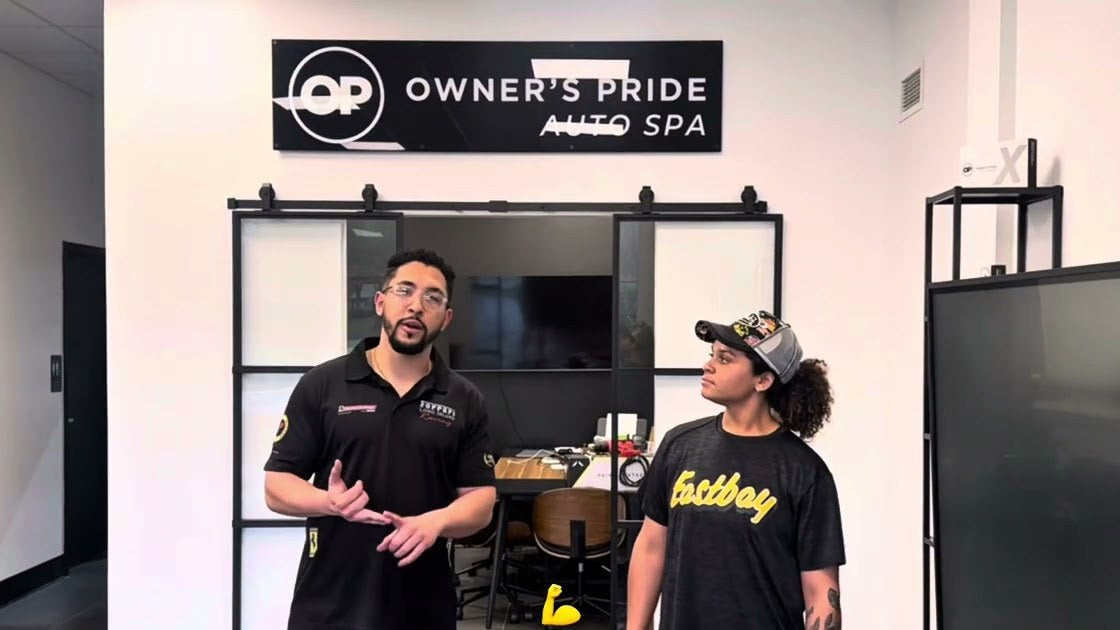
Quick answer: In Florida heat, ceramic window tint is the film many installers recommend because it targets infrared energy, the part of sunlight that causes most of the heat you feel, without having to be darker. That matters because Florida law requires front side windows to let at least 28% of visible light through. Tint Academy's 2-day Orlando Window Tint Certification on December 12–13, 2026 at Owner's Pride Auto Spa teaches film types, hands-on installation and how to sell the right film, and every student keeps a 100 ft. roll of ceramic film.
Register: Orlando Dec 12–13 Window Tint Class
Tint Academy has trained 6,500+ students over 10 years. To see what the certificate covers, visit our window tint certification page, or read our full window tint school in Orlando guide.

Why Florida Customers Ask About Heat First
Tint Academy's Orlando course page puts it simply: window tinting is a popular automotive service in Florida, where customers regularly look for solutions for heat, glare, UV exposure, privacy and vehicle appearance. Heat is usually the first thing an Orlando customer mentions, and it is where a well-trained installer can stand out.
The catch is that the darkest film is not always the coolest, and in Florida you can't simply go darker on the front windows to cut heat.
Florida's 28% Rule and Why It Points to Ceramic
Under Florida Statute 316.2953, sunscreening material on the side windows beside and forward of the driver is allowed only if, when tested on that vehicle, it has a visible-light transmittance of at least 28% and a visible-light reflectance of no more than 25%. A violation is a noncriminal, nonmoving traffic infraction. (Rear-window rules are in other sections of the statutes, so check the current law before you quote.)
So when a customer wants the front of their car cooler, the answer usually isn't a darker shade. It is a film that rejects more heat at a legal darkness. That is exactly where film technology matters.
Dyed vs Carbon vs Ceramic: What Orlando Installers Should Know
Where the heat actually comes from
Sunlight reaches the car as visible light, infrared energy and UV rays. Infrared energy, not visible light, causes most of the heat you feel. That is why two films with the same darkness (VLT) can perform very differently on a Florida afternoon.
How ceramic film works
Despite the name, ceramic film doesn't contain ceramic like a coffee mug or a floor tile. It is made using nanotechnology: microscopic nano-ceramic particles embedded through layers of polyester film. Those particles absorb and scatter infrared energy before it heats the cabin, which helps keep interiors cooler, reduces AC demand, and protects leather, vinyl and electronics from long-term sun damage. Unlike metallic film, ceramic film doesn't interfere with GPS, Bluetooth or cell signal.
Selling the right film
Ceramic costs more, so customers need to understand what they are paying for. At Tint Academy, students learn to explain this in simple, customer-friendly terms so they can build trust and recommend the right film with confidence. For a deeper comparison, read carbon vs ceramic window tint, see how the films look side by side in dyed vs carbon vs ceramic tint, and learn how to tell if tint is really ceramic.
Watch: Ceramic Window Film Explained
In this Tint Academy video, we break down how sunlight splits into visible light, infrared and UV, why infrared causes most of the heat, how ceramic differs from dyed and metallic film, and why two films with the same VLT can perform very differently.
What You Learn at the Orlando Window Tint Class

Knowing films is only useful if you can install them cleanly. About 80% of the Orlando course is hands-on: cutting, shrinking, installing, removing and finishing film on real vehicles with an instructor guiding you. Classes are kept small so you get more time on the car and less time watching from the sidelines.
Day 1: foundations and side windows
Tint theory and fundamentals, working with customers, installation drills, framed roll-down windows and 2-stage installs, quarter windows, frameless roll-down windows, tint removal, sun strips and banners, and marketing and business fundamentals.
Day 2: rear windows and complete vehicles
Review and more hands-on practice, hatchback and sedan rear window preparation and installation, rear window tint removal, trucks and SUVs, a plotter overview, an introduction to residential window film, and marketing, pricing and booking customers.
Skills covered across both days
- Glass cleaning and vehicle preparation
- Understanding window film and different film types
- Film handling, hand cutting and heat shrinking
- Bottom-loading techniques and multiple installation methods
- Contamination prevention, edge finishing, and avoiding bubbles and common mistakes
What's included
Registration includes a professional tint tool kit and a 100 ft. roll of ceramic automotive window film that you keep, Tint Academy Certification, the online window tint training course, business and pricing training, marketing and customer acquisition guidance, supplier access, lifetime mentor support, a student support community, and free future observation or re-attendance opportunities. No previous tinting experience is needed.
Professional automotive tint jobs are commonly priced at several hundred dollars depending on the vehicle, film, market and scope of work. Your results depend on your skill, pricing, location, material costs, expenses and how much work you book. Tint Academy does not guarantee income or employment. Thinking about the business side? Read our guide to starting a window tint business in Orlando.
Orlando Window Tint Course: December 12–13, 2026
- Dates: Saturday December 12 and Sunday December 13, 2026
- Time: 9:00 AM to 5:00 PM each day
- Venue: Owner's Pride Auto Spa Orlando, 8340 Southpark Cir #140, Orlando, FL 32819
- Regular tuition: $1,299
- Limited Early-Bird: $996 full pay (save $303), or a $350 deposit today with $1,099 total and $749 remaining at class. Early-Bird seats are limited, so contact the team before paying.
- Experience needed: none
How to register
Call or text the registration team with your name, say you want the Orlando December 12–13 class, and ask about the $303 Early-Bird discount. If a discounted seat is still open, they'll confirm it and send the correct payment link. Or register directly on the Orlando window tint course page. Comparing options? See how much window tint training costs. If you also want to offer paint protection film, see our PPF training page.
Call or text: 321-364-9518 (USA)
Register: Orlando Dec 12–13 Window Tint Class
Frequently Asked Questions
Is ceramic window tint worth it in Florida?
For many Florida drivers, yes. Most of the heat you feel through glass comes from infrared energy, not visible light. Ceramic film uses nano-ceramic particles to absorb and scatter infrared energy, so it can keep a cabin cooler without needing to be darker. That matters in Florida, where front side windows must still let at least 28% of visible light through.
How dark can window tint be on front side windows in Florida?
Under Florida Statute 316.2953, film on the side windows beside and forward of the driver must have a light transmittance of at least 28% in the visible range and a visible-light reflectance of no more than 25%, measured on the vehicle. Rear-window rules are in separate sections of the statutes, so check the current law before quoting a job.
Why does ceramic tint cost more than dyed tint?
Ceramic film is built with nanotechnology: microscopic nano-ceramic particles embedded in layers of polyester film. That construction targets infrared heat rather than just darkening the glass, and it doesn't interfere with GPS, Bluetooth or cell signal the way metallic film can. Installers who can explain this clearly find it easier to sell the upgrade.
Does the Orlando course teach different film types?
Yes. Understanding window film and different film types is part of the curriculum, along with glass cleaning and prep, film handling, hand cutting, heat shrinking, side and rear windows, tint removal, and how to avoid bubbles and contamination. Every student also leaves with a 100 ft. roll of ceramic automotive window film.
When and where is the next Orlando window tint class?
December 12–13, 2026, 9:00 AM to 5:00 PM each day, at Owner's Pride Auto Spa Orlando, 8340 Southpark Cir #140, Orlando, FL 32819.
How much is the Orlando window tint course?
Regular tuition is $1,299. A limited number of Early-Bird seats are $996 full pay (save $303), or you can reserve with a $350 deposit ($1,099 total, $749 remaining at class). Call or text 321-364-9518 to check Early-Bird availability before paying.

Share and get 15% off!
Simply share this product on one of the following social networks and you will unlock 15% off!