


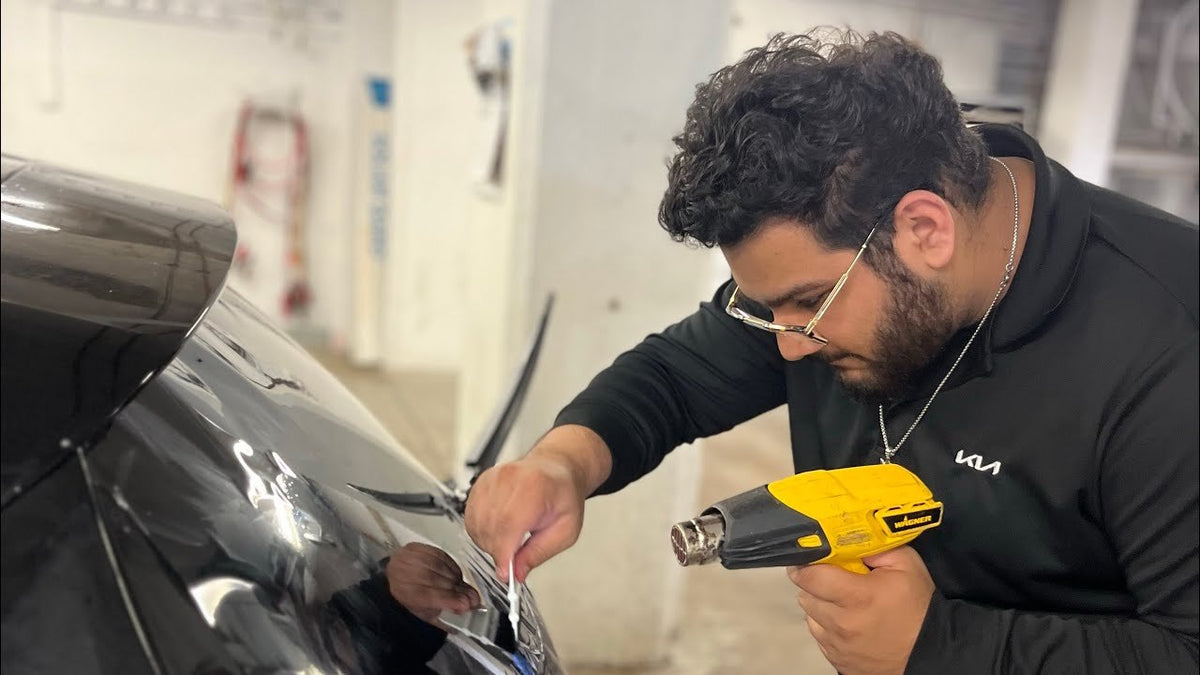
Quick answer: To cut window tint without scratching the glass, use a fresh stainless steel snap-off blade, snap it every few cuts, hold it at a low angle (the IWFA recommends 10–30 degrees), and use only enough pressure to get through the film. If you don't trust your knife control yet, use a method that keeps the blade off the glass entirely: the Sharpie method, a tape outline, or a plotter.
Scratched glass is one of the most expensive beginner mistakes in window tinting, because you can't polish it out of a customer's door glass. The good news is that almost every scratch comes from the same few habits, and all of them can be fixed. This guide covers the blade, angle, pressure and cut order Tint Academy teaches, plus three ways to cut film without touching the glass at all.

Why window tint cutting scratches glass
The IWFA's automotive installation guidelines put it bluntly: glass is soft, and an installer has to learn to hold the knife so it doesn't scratch the surface. The guidelines list four causes of scratched glass:
- A dull knife blade
- A blade that isn't stainless steel
- A cutting angle steeper than 15 degrees
- Pressing too hard, especially in combination with any of the above
Notice that three of the four are about the blade itself. Most scratches aren't a talent problem. They're an equipment and habit problem. (Scratches can also show up after an install that were already in the glass. We explain that in why scratches may appear on windows after tint is applied.)
How to hand cut window tint without scratching: 5 steps
In the video below, a Tint Academy instructor walks through the exact cutting habits taught in class: blade choice, blade freshness, angle and pressure, and a practice drill.
Video: "Hand Cutting Window Tint? NEVER Scratch a Window (Pro Installer Tips)" from Tint Academy's YouTube channel. It covers blade control, avoiding scratches on glass and defrosters, and when to hand cut versus use a plotter.
1. Use a stainless steel snap-off blade
3M's Scotchtint automotive installation instructions recommend a stainless blade over standard steel, because it will not scratch glass when proper pressure is applied. In the video, the instructor uses an OLFA AB50S stainless blade and explains why: harder carbon-steel blades from the hardware store are more rigid and can cut into the glass.
2. Snap the blade early and often
Stainless blades lose their sharpness faster, so a fresh tip matters. 3M says never to use the same tip for more than three cuts. Tint Academy recommends snapping the blade every two or three windows. The IWFA guideline sums it up: it's cheaper to snap a new blade than to replace a piece of scratched glass.
3. Keep the blade at a low angle
The IWFA recommends a blade angle of 10 to 30 degrees to the glass. If you hold the knife like a pen, you'll usually be at 40 to 50 degrees, which lets the point dig in. Rest your hand on top of the knife instead. In the video, the instructor keeps the blade at about 30 degrees and explains that the higher the angle, the more the blade bites into the window.
4. Use light, controlled pressure
You want just enough pressure to go through the film and touch the glass, not push into it. Tint Academy's course book calls for very light pressure, and the instructor demonstrates how little that is in the video. If you find yourself needing more force, the blade is dull. Snap it.
5. Start at the bottom and work up
Tint Academy teaches starting cuts low on the window and working upward. Entering the film leaves a small mark, and starting low keeps it where no one sees it and where it won't catch. Enter the film with no blade extended so you don't pierce it and create a gap, then extend the blade one click once you've found your corner. Too much exposed blade gets flimsy and cuts unevenly.

3 ways to cut window tint without a blade on the glass
If you're a beginner, or the car has glass you're nervous about, you can take the blade off the glass entirely.
The Sharpie method
Mark the glass outline on the film, then cut on your line away from the car, on a clean surface. The blade never touches the window.
Video: "Stop Scratching Glass: The Sharpie Method for Cutting Window Tint" from Tint Academy's YouTube channel. It shows how to trace, shrink and cut film safely, when the method works best and when it doesn't, and how to avoid scratching glass, seals and defroster lines.
Not sure whether to learn this first or go straight to hand cutting? Read Sharpie method vs. hand cutting for beginners.
Tape outline method for small windows
On 1/4 and blind spot windows, Tint Academy also demonstrates using vinyl tape to outline the glass so the knife can't reach the window, in its tape method video. For the full small-window process, see how to tint 1/4 and blind spot windows.
Some installers also use a filament cutting tape. 3M's Knifeless Tape instructions say to pull the filament back along the cut line, not upward, to slice the film cleanly.
Plotter-cut patterns
A plotter cuts the pattern before the film touches the car. It's fast and clean once you're set up, but Tint Academy still teaches hand cutting too. As the instructor notes in the video, installers who work at dealerships and other shops often cut directly on the car.

A simple cutting drill to build control
In the video, the instructor shows a "10 strip" step-cutting drill. Put a hard card behind a scrap of film, spray behind it to anchor it, then make 10 cuts in a row, shifting the film each time, so the angle and pressure become automatic. Pair it with the drills in how to practice window tinting: 7 beginner drills, and make sure your kit is right with the essential window tint tools every beginner needs.
Learn hand cutting hands-on
Reading about blade angle helps. Having an instructor watch your cuts on a real car helps more. Tint Academy's 2-day hands-on window tint course runs in cities across Canada and the USA, 9:00 AM to 5:00 PM both days, in small classes on real vehicles. No experience is needed. Students take home a professional tool kit and a 100 ft roll of ceramic window film, earn window tint certification, and get the online course and lifetime mentor support after class. Tint Academy has trained more than 6,500 students over 10 years.
See Upcoming Window Tint Classes
Questions? Call or text: 321-364-9518 (USA) or 289-201-2070 (Canada).
FAQ: cutting window tint without scratching glass
Can you cut window tint directly on the car glass?
Yes. Most installers trim film right on the glass with a snap-off knife. It is safe when the blade is fresh, stainless, held at a low angle and used with light pressure. If you're not confident yet, use a no-blade-on-glass method such as the Sharpie method, a vinyl tape outline, or a plotter.
What blade should I use to cut window tint?
Use a stainless steel snap-off blade. 3M's Scotchtint installation instructions recommend stainless over standard steel because it will not scratch glass when proper pressure is applied. In Tint Academy's hand-cutting video, the instructor uses an OLFA AB50S stainless blade and warns that harder carbon blades can cut into the glass.
How often should I snap my blade when tinting?
Often. 3M says to never use the same tip for more than three cuts, and Tint Academy recommends snapping the blade every two or three windows. A dull tip needs more pressure, and more pressure is what scratches glass.
What angle should the knife be when cutting tint on glass?
Keep it low. The IWFA automotive installation guidelines say 10 to 30 degrees, and list a cutting angle steeper than 15 degrees as one cause of scratched glass. Holding the knife like a pen usually puts it at 40 to 50 degrees, which is too steep.
What is the Sharpie method for window tint?
You mark the outline of the glass on the film with a marker, then cut on the line away from the glass, so the blade never touches the window. Tint Academy teaches it as a safe option for beginners and shows how to trace, shrink and cut film in its Sharpie method video.
Do Tint Academy courses teach hand cutting?
Yes. The 2-day hands-on window tint course covers hand cutting along with prep, heat shrinking and installing side and rear windows on real vehicles. Students take home a professional tool kit and a 100 ft roll of ceramic window film, and earn Tint Academy certification.

Share and get 15% off!
Simply share this product on one of the following social networks and you will unlock 15% off!