


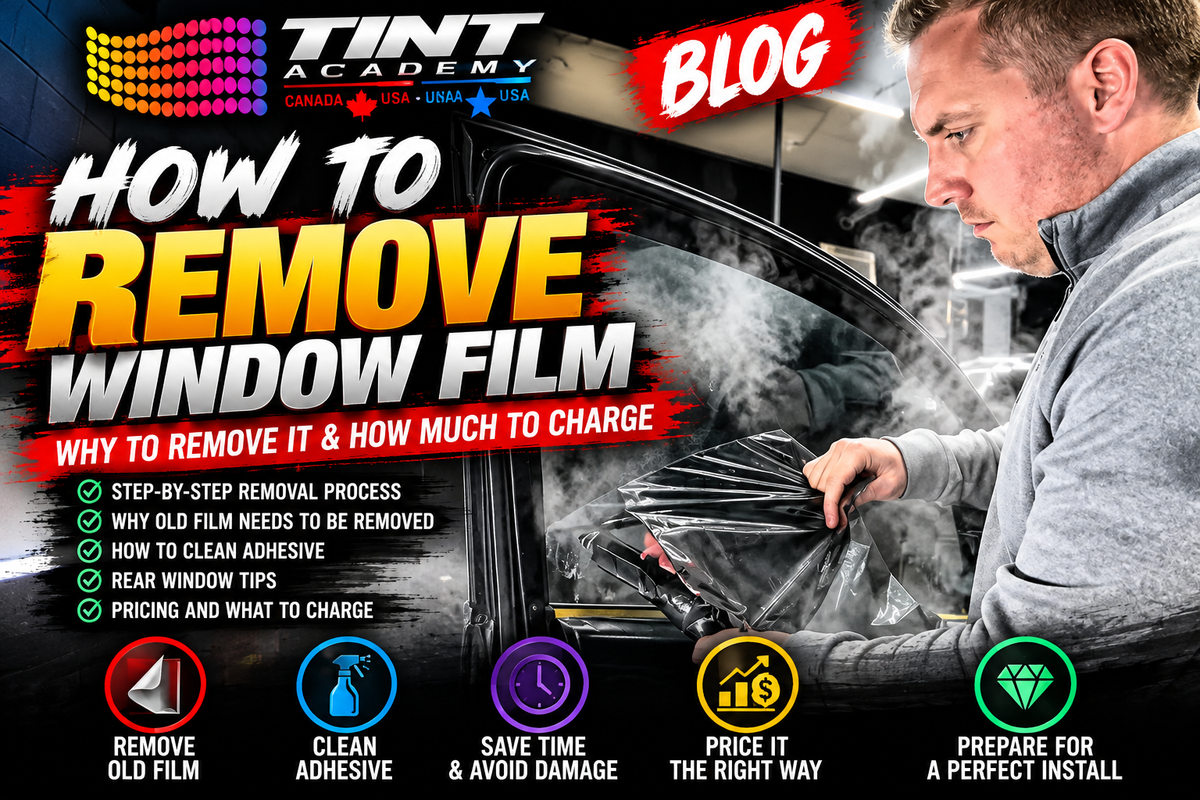
How to Remove Window Tint: Professional Window Tint Removal & Pricing Guide
Knowing how to remove window tint is an important skill for any professional window tint installer.
Customers don't always bring you clean, untouched glass.
Sometimes you're dealing with window film that has been installed for years. It may be bubbling, peeling, fading, turning purple or simply no longer meeting the customer's needs.
Before new window tint can be professionally installed, that old film often needs to come off.
But there's another important part of window tint removal that new installers sometimes overlook:
Window tint removal is a service—and you should charge for it.
At Tint Academy, we teach students that running a successful window tint business isn't just about knowing how to install film.
You also need to understand removal, preparation, troubleshooting, customer expectations, labour time and pricing.
This guide explains why window film needs to be removed, how professional installers approach tint removal and how to think about pricing window tint removal services.
Why Do You Need to Remove Old Window Tint?
There are many reasons a customer might need old automotive window film removed.
Sometimes the existing tint has failed. Other times, the film may still be intact but the customer wants a different shade or wants to upgrade to another film technology.
Common reasons include:
- Bubbling window tint
- Peeling or lifting film
- Faded or discolored tint
- Purple window tint
- Adhesive failure
- Contaminated or poorly installed film
- Scratched or damaged film
- Changing to a different tint percentage
- Upgrading to ceramic window tint
- Replacing an older film
- Removing film to meet applicable tint regulations
Whatever the reason, you need a clean, properly prepared surface before installing new film.
Trying to shortcut preparation can compromise the finished installation.
Can You Install New Window Tint Over Old Window Tint?
This is a common question:
Can you tint over existing aftermarket window tint?
For a professional replacement installation, removing failing or unwanted aftermarket film and properly preparing the glass is generally the better approach.
Installing new film over deteriorated film doesn't solve the problems underneath it.
If the existing film has bubbles, contamination, adhesive problems or deterioration, those issues remain.
There's also an important distinction between aftermarket window film and factory privacy glass.
Many trucks and SUVs have dark glass from the factory. This isn't necessarily aftermarket film that needs to be peeled off.
Understanding the difference is important for both installers and customers.
How to Remove Window Tint From a Car
The exact removal technique depends on the film, adhesive, age of the installation, glass and vehicle.
In general, the objective is straightforward:
Remove the film while minimizing adhesive residue and avoiding damage to the vehicle or glass components.
A professional process generally involves evaluating the existing film, carefully lifting an edge, using an appropriate removal technique to separate the film from the glass, and then removing any remaining adhesive before preparing the glass for the next installation.
Watch Tint Academy's Window Tint Removal Video
For a visual demonstration, watch our window tint removal video:
How to Remove Window Tint – Tint Academy Video
Step 1: Inspect the Existing Window Tint
Before you start pulling film, inspect the vehicle.
Look at the condition of the tint.
Is it bubbling?
Is it peeling?
Is the film extremely old?
Has it separated from the adhesive?
Is there already damage to the glass?
Is it on a side window or rear windshield?
The condition of the existing film can dramatically affect the amount of labour required.
Some window film can come off relatively cleanly.
Other jobs can turn into a significant adhesive-removal project.
That's one reason professional installers should inspect before giving a final removal price whenever possible.
Step 2: Identify the Type of Glass
Not every window should be treated exactly the same.
Removing tint from a door window is different from working on a rear windshield containing defroster lines.
Those thin lines across the rear glass serve an important function and require extra care during removal and cleanup.
A professional installer should understand the glass they're working on before beginning the job.
Step 3: Remove the Window Film Carefully
The goal is to encourage the film and adhesive to release as cleanly as possible rather than simply ripping the film away.
Film age, adhesive condition and temperature can all influence how easily it releases.
A film that comes off in large sections can dramatically reduce cleanup time.
Film that separates, tears repeatedly or leaves significant adhesive behind will require considerably more labour.
This is why two vehicles with apparently similar tint can result in very different removal times.
Step 4: Remove Leftover Window Tint Adhesive
Getting the film off isn't necessarily the end of the job.
You may still have adhesive residue on the glass.
That residue needs to be properly addressed before a clean replacement installation can be performed.
Poor adhesive cleanup can contribute to:
- Contamination
- Visible residue
- Installation problems
- Poor film appearance
- Additional installation time
For an installer, preparation is part of the installation.
A beautiful tint job starts with clean glass.
How to Remove Window Tint From a Rear Window
Rear-window tint removal deserves special attention.
Why?
Defroster lines.
Rear windshields commonly contain electrical defroster elements on the glass. Careless removal or scraping can potentially damage these components.
This means rear-window film removal can involve additional time, patience and risk compared with a basic side-window removal.
For a tint business, that should also factor into pricing.
Don't automatically price every piece of glass the same way.
Difficulty matters.
Time matters.
Risk matters.
Why Does Window Tint Bubble?
One of the most recognizable signs of failing tint is bubbling.
Bubbles can develop for different reasons, including deterioration or failure within the film/adhesive system and installation-related problems.
There is also an important difference between temporary moisture after a fresh installation and film that has genuinely failed.
Customers sometimes see a newly tinted window during the curing process and assume something is wrong.
An experienced installer should be able to explain the difference.
But when older film is covered in permanent bubbles or has experienced adhesive failure, replacement may require removing the existing film and preparing the glass again.
Why Does Old Window Tint Turn Purple?
You've probably seen older vehicles with window film that has developed an obvious purple appearance.
Discoloration can occur as certain films age and their components deteriorate after prolonged exposure to sunlight and environmental conditions.
Modern professional films can offer much better color stability, depending on their construction and quality.
This is also why installers need to understand the difference between cheap film and professional-quality window film.
Customers aren't only paying for darkness.
They're buying the film technology, installation and service behind it.
How Much Does Window Tint Removal Cost?
Now we get to one of the most important business questions:
How much should you charge to remove window tint?
There isn't one universal price.
Window tint removal pricing can depend on:
Number of windows
Vehicle type
Age of the film
Condition of the film
Amount of adhesive remaining
Rear-window complexity
Defroster lines
Accessibility
Total labour time
Local market pricing
The mistake is assuming:
“They're buying new tint from me, so I'll just remove the old stuff for free.”
That can quickly turn a profitable installation into hours of unpaid labour.
Window Tint Removal Pricing: Charge for Your Time
Think about it from a business perspective.
Suppose you schedule a customer expecting a straightforward installation.
The customer arrives and you discover that the entire vehicle already has deteriorated aftermarket tint.
Now you need to:
Remove the old film.
Deal with leftover adhesive.
Clean and prepare every window.
Take additional precautions on the rear windshield.
Then begin the installation you originally booked.
The job has changed.
Your invoice should reflect that additional work.
Window tint removal should generally be considered a separate service or additional labour item, not something automatically included at no cost.
Ask This Question Before Booking a Tint Job
One simple question can prevent a major pricing problem:
“Does the vehicle currently have aftermarket window film installed?”
Ask this before confirming the job.
If the customer doesn't know, you may need to inspect the vehicle.
You can also ask:
Is the film bubbling or peeling?
How many windows currently have tint?
Is there tint on the rear windshield?
Do you know approximately how old it is?
These questions give you a better idea of what you're walking into.
How Much Should a Tint Shop Charge Per Hour?
Every shop needs to understand its own labour rate.
Your labour isn't free simply because you're performing a service you're good at.
Your pricing needs to account for more than the film itself.
A tint business can have expenses including:
- Window film
- Tools
- Blades and consumables
- Slip solution
- Towels and cleaning supplies
- Rent
- Utilities
- Insurance
- Marketing
- Software
- Payment processing
- Employees
- Taxes
- Equipment
- Training
- Your time
This is why blindly copying the tint shop down the street isn't a pricing strategy.
Know your numbers.
If removing film adds significant labour to a job, that labour needs to be considered when calculating the price.
Should Tint Removal Be Free If the Customer Buys New Tint?
This is ultimately a business decision, but don't make the mistake of assuming it has to be free.
You might choose to include removal as part of a promotion or package.
That's different from not realizing what the service is worth.
If a removal requires substantial labour, you're absorbing that cost somewhere.
Professional businesses should understand the cost before deciding whether to charge separately, package it into the price or intentionally discount it.
Tint Removal Can Become an Additional Revenue Stream
Window tint removal isn't just an inconvenience.
It's another service your shop can provide.
Consider the services surrounding a replacement tint job:
Old film removal → adhesive cleanup → glass preparation → new film installation → premium film upgrade.
Instead of looking at old film and thinking:
“This job is going to take longer.”
A business owner can think:
“This customer needs an additional service.”
That's an important shift in mindset.
Window Tint Removal and Ceramic Tint Upgrades
Removal also creates an opportunity to educate customers about newer film options.
A customer with old, faded or deteriorated film may not know how much window-film technology has changed.
When replacing the film, explain the available options.
Depending on the films you carry, that could include:
Dyed Window Tint
Often an entry-level option for customers primarily interested in appearance, privacy and affordability.
Carbon Window Tint
Depending on the product, carbon films may offer improved color stability and solar performance.
Ceramic Window Tint
Premium ceramic films are often marketed around enhanced solar and infrared performance, optical clarity and durability.
Don't simply ask:
“How dark do you want it?”
Ask what the customer wants the film to accomplish.
That creates a much better sales conversation.
Window Tint Removal vs Installation: Why Installers Need Both Skills
Learning to install window film is only one part of becoming a professional window tinter.
Real customers bring real problems.
You need to know what to do when you encounter:
Old tint
Adhesive residue
Contamination
Difficult rear windows
Defroster lines
Failed film
Previous poor installations
The installer who can diagnose and solve these problems becomes more valuable than someone who only knows how to install film on perfectly prepared glass.
Learn Professional Window Tinting With Tint Academy
At Tint Academy, our training is built around hands-on experience.
Our 2-Day Window Tint Certification Courses help students develop the fundamentals required to begin building their installation skills.
Training topics can include:
- Window preparation
- Contamination control
- Film handling
- Cutting window film
- Side-window installation
- Quarter windows
- Bottom loading
- Two-stage installation
- Rear-window heat shrinking
- Tools and equipment
- Film knowledge
- Installation troubleshooting
- Pricing and business fundamentals
Whether you want to start a window tint business, add tinting to an existing detailing operation or develop another automotive skill, learning professional technique is the foundation.
Frequently Asked Questions About Window Tint Removal
What is the easiest way to remove old window tint?
The easiest method depends on the film, adhesive, age and glass. Professional installers assess the film first and use a method designed to encourage the film and adhesive to release while minimizing cleanup and risk.
Can I peel window tint off?
Some films may peel away relatively easily, while deteriorated films can separate, tear or leave significant adhesive behind. Rear glass also requires additional care because of defroster components.
How do you remove window tint adhesive?
The appropriate process depends on the glass and adhesive. The objective is to remove residue thoroughly without damaging surrounding vehicle components or rear defroster elements.
How much should window tint removal cost?
There is no universal price. Cost depends on the number of windows, film condition, vehicle, adhesive, labour time and complexity of the removal.
Should a tint shop charge for removing old tint?
Removal requires labour and can increase the amount of time required to complete the vehicle. Shops should account for that labour when setting the total job price, whether it appears as a separate charge or is intentionally incorporated into a package.
Can you put new tint over old tint?
For a professional replacement of unwanted or failing aftermarket film, removing the old film and properly preparing the glass generally provides a better foundation for the new installation.
Can you remove rear-window tint without damaging the defroster?
Rear-window removal requires particular care because of the defroster elements. Professional technique and patience are especially important in this area.
Watch: How to Remove Window Film
Want to see the process?
Tint Academy created a video covering window tint removal, why film needs to be removed and the pricing considerations installers should think about.
Watch: How to Remove Window Tint – Tint Academy
If you're an installer, don't think of removal as something you have to throw in for free.
Learn the process. Understand the labour. Price your time.
Start Your Window Tint Training With Tint Academy
If you're searching Google for how to tint windows, how to remove window tint, window tint training, window tint certification, automotive window tint courses, how to start a tint business or professional window tint classes, Tint Academy offers hands-on training across Canada and the United States.
Installation is only part of becoming a professional.
You also need to learn how to solve problems, work efficiently, understand products and charge appropriately for your skill and time.
Tint Academy

Share and get 15% off!
Simply share this product on one of the following social networks and you will unlock 15% off!