


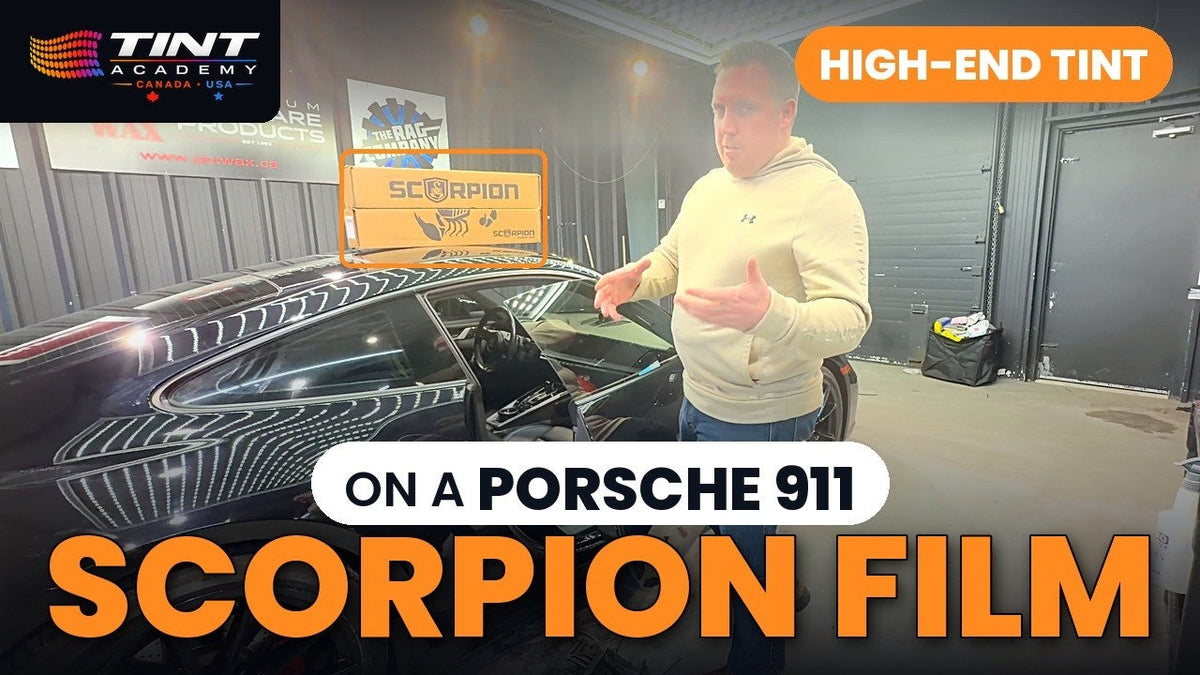
If you install tint or you're shopping for it, you've probably seen Scorpion film in shops across the USA and Canada. This guide breaks down the five Scorpion automotive window film series, Carbon, Carbon Plus, King, Shield and Shield Plus, using the numbers Scorpion publishes on its own product pages. We link to each source so you can check the latest specs yourself.
Tint Academy has trained 7,500+ students over 10 years, and Scorpion is the film we recommend to our students. We are an official Scorpion Window Film training partner, but the specs below are Scorpion's, not ours.
Who Makes Scorpion Window Film?
Scorpion Window Film is a division of Scorpion Protective Coatings. On its About page, Scorpion says it was founded in 1996, is family-owned and supplies film for automotive, architectural, safety and specialty jobs. Its automotive film page says the film is designed and manufactured in the USA.
Scorpion sells automotive film through authorized dealers. According to its How to Buy page, that's how it ensures proper installation, performance and warranty coverage. Installers buy through distributors, or directly from Scorpion where there's no distributor in the region.
The 5 Scorpion Automotive Series at a Glance
All five series are 1.5 mil, dual-ply films sold in 100 ft rolls in 20", 24", 36", 40" and 60" widths. Scorpion lists 99% UV rejection and a lifetime warranty for each one. The differences are in construction, shade options and heat rejection:
| Series | Construction | Shades (VLT) | Published heat numbers | UV | Signal |
|---|---|---|---|---|---|
| Carbon | Carbon deposit, non-metalized, no dyes | ZERO (3%), 5, 15, 20, 35, 40, 50, 70% | At ZERO (3%): TSER 56%, IRR 35%, SHGC 0.44 (series IR rating 33%+) | 99% | Signal friendly (no metal) |
| Carbon Plus | Carbon deposit with an extra carbon layer, non-metalized | 5, 15, 20, 35, 40, 50% | At 5%: TSER 59%, IRR 62%, SHGC 0.41 | 99% | Signal friendly (no metal) |
| King | Carbon-metalized (carbon layer + metalized layer) | 5, 15, 20, 35, 50% | IR rating 48–50% | 99% | Listed by Scorpion as signal friendly |
| Shield | Nano-ceramic (carbon + ceramic particle blend), non-metalized | 5, 15, 20, 35, 40, 50% | IRR 82–87%, TSER 52–66% depending on shade (5%: TSER 66%, SHGC 0.34) | 99% | Signal friendly (no metal) |
| Shield Plus | Nano-ceramic IR, non-metalized | 5, 15, 20, 35, 40, 50, 70% | IRR 93–95%, TSER 53–70% depending on shade (5%: TSER 70%, SHGC 0.30) | 99% | Signal friendly (no metal) |
Source: Scorpion's product pages for Carbon, Carbon Plus, King, Shield and Shield Plus (checked November 12, 2026). TSER = total solar energy rejected, IRR = infrared rejection, SHGC = solar heat gain coefficient (lower means less heat gets through). Scorpion publishes some figures at different shades, so compare series at the same VLT on Scorpion's spec sheets before quoting a customer.
Carbon Series: Entry-Level Carbon Film
Scorpion describes Carbon as a color-stable carbon film that uses carbon deposit technology "in place of dyed polyester," so it resists fading and rejects more heat than dyed films. It has no metal and no dyes, and it has the widest shade range in the lineup, from ZERO (3%) up to 70%. For a lot of shops it's the everyday film for a standard tint package.
Carbon Plus Series: Carbon With More Heat Rejection
Carbon Plus adds an extra carbon deposit layer to the standard Carbon construction. Scorpion lists 62% infrared rejection at 5% VLT, compared with 35% IRR for Carbon at ZERO (3%). It comes in six shades from 5% to 50%.
Carbon Plus is also the film Adam reaches for when he wants a beginner to practise a back window. In this short he shrinks a full rear windshield with it:
King Series: Carbon-Metalized
King combines a carbon layer with a metalized layer. Scorpion says this gives "great optical clarity and increased heat rejection," and lists an IR rating of 48–50%. King comes in five shades (5, 15, 20, 35 and 50%). Scorpion lists it as signal friendly, but it's the only metalized series in the automotive lineup, so mention that to customers who ask about metal in their film.
Shield Series: Nano-Ceramic
Shield is Scorpion's first nano-ceramic step. Scorpion describes it as a carbon and ceramic particle blend with no metal. It lists infrared rejection of 82–87% and TSER of 52–66% depending on the shade, and six shades from 5% to 50%. When a customer asks for "ceramic tint" and wants strong heat rejection, this is the series most shops will show them.
Shield Plus Series: Nano-Ceramic IR
Scorpion calls Shield Plus its highest-performing automotive window film. It lists infrared rejection of 93–95% and TSER of 53–70% depending on the shade. It's also the only Scorpion ceramic offered in 70%, a light shade that's useful when customers want heat rejection without much darkness. Always check local laws before tinting a windshield or front side windows.

Carbon vs Ceramic: How the Lineup Fits Together
- Carbon and Carbon Plus are non-metal carbon films. They're the value end of the lineup, with Carbon Plus adding infrared rejection.
- King is the carbon-metalized option. Scorpion highlights its optical clarity and heat rejection.
- Shield and Shield Plus are the nano-ceramic options, with the highest infrared rejection Scorpion publishes for automotive film.
Deciding which ones to stock and how to present them to customers is its own topic. Our next guide covers which Scorpion window film to offer your customers.
Beyond Automotive Tint
Scorpion's catalog goes beyond car film. It includes architectural film for homes and commercial buildings, safety and security film that helps hold broken glass together, Sentry paint protection film, plotters and the SCAN pattern-cutting app. If you're building a tint business, it helps to know the brand covers flat glass and PPF too.
Learn to Install Scorpion Film Hands-On
Specs help you sell the job, but the install is what the customer sees. Tint Academy's 2-day hands-on window tint course runs in cities across Canada and the USA, including classes at Scorpion Films' headquarters in Cloverdale, Indiana. See every date on our course list, read why we recommend Scorpion window film to our students, or pick up installation tips in how to install Scorpion window film.
Call or text: Canada 289-201-2070 · USA 321-364-9518
Frequently Asked Questions
What types of window film does Scorpion make for cars?
Scorpion's current automotive lineup has five series: Carbon, Carbon Plus, King, Shield and Shield Plus. Carbon and Carbon Plus are carbon films, King is a carbon-metalized film, and Shield and Shield Plus are nano-ceramic films. Scorpion also makes architectural, safety and security, and paint protection films.
Is Scorpion window film ceramic?
Two of Scorpion's five automotive series are nano-ceramic: Shield and Shield Plus. Scorpion describes both as a carbon and ceramic particle blend with no metalized particles. Carbon, Carbon Plus and King are not ceramic films.
Which Scorpion film has the highest heat rejection?
Scorpion calls Shield Plus its highest-performing automotive window film. Its product page lists infrared rejection of 93–95% and total solar energy rejection of 53–70% depending on the shade.
Does Scorpion window film have a warranty?
Scorpion's product pages list a lifetime warranty for all five automotive series. Scorpion sells its automotive film through authorized dealers, so ask your installer how they register the warranty for your vehicle.
Where is Scorpion window film made?
Scorpion says its window film is designed and manufactured in the USA. Scorpion Window Film is a division of Scorpion Protective Coatings and has supplied window film since 1996.
Is Scorpion film legal in my province or state?
Every Scorpion series comes in several shades, and the shade (VLT) is what tint laws regulate, not the brand. Check the limits for each window in your province or state before you install.
Ready to learn it hands-on? See all upcoming window tint classes or call or text us: Canada 289-201-2070 · USA 321-364-9518.

Share and get 15% off!
Simply share this product on one of the following social networks and you will unlock 15% off!