


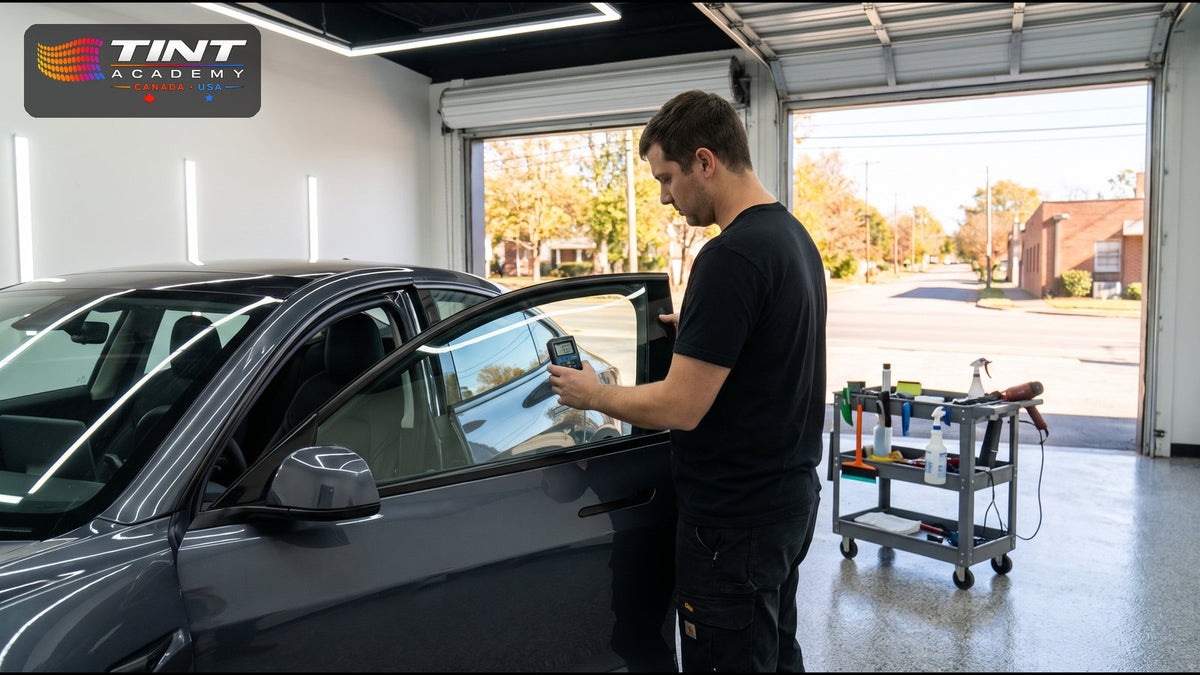
Tennessee window tint law (T.C.A. § 55-9-107) sets a 35% visible light transmittance minimum for tint material and a 70% limit on the windshield below the factory shade band, and it puts specific duties on the installer: a compliance label on the driver’s window and a signed receipt for every car. This guide explains them in plain English, then covers Tint Academy’s next hands-on Nashville class on December 19–20, 2026 at Lunar Window Tint, 3730 Dickerson Pike Ste 103, Nashville.
Register: Nashville Dec 19–20 Window Tint Class
Tint Academy has trained 6,500+ students over 10 years. See what the certificate covers on our window tint certification page, or read what a 2-day window tint training class covers.
Tennessee Window Tint Law at a Glance
Tennessee’s tint rules are in Tennessee Code Annotated § 55-9-107 (tinted motor vehicle windows). The core limits:
- Windows: it is unlawful to drive on a public highway, street or road with any window altered by material that has a visible light transmittance below 35%.
- Windshield: except for the manufacturer’s standard installed shade band, material may not reduce the windshield’s visible light transmittance below 70%.
- Front door windows: the statute says none of its vehicle exemptions remove front door windows from the 35% rule.
- Penalty: violating the section, or refusing a field comparison test when an officer directs it, is a Class C misdemeanor.
This is a plain-English summary for installers, not legal advice. The legislature has amended the section several times, most recently in 2024, so always check the current text before you take paid work.
Who counts as a “professional installer”
Subsection (a)(2) defines a professional installer as anyone who installs window tinting materials in Tennessee for profit, barter, wages or commissions. It is unlawful for a professional installer to apply tint that puts a vehicle out of compliance. That covers mobile tinters and detailers who add tint as a side service, not just shop owners.
The Label and Receipt Every Tennessee Tint Job Needs
Tennessee gives the installer two paperwork jobs on every car.
1. The driver’s window compliance label
Under subsection (a)(3), professional installers must supply and affix an adhesive label to the lower right corner of the driver’s window. The commissioner of safety sets its size and style, and it must include:
- The installer’s business name, and
- The legend “Complies with Tennessee Code Annotated, § 55-9-107.”
2. The signed customer receipt
Under subsection (a)(4), each customer gets a signed receipt for each vehicle that includes:
- The date of installation
- The vehicle’s make, model, paint color, and license plate number and state
- The legend “Complies with Tennessee Code Annotated, § 55-9-107, at date of installation”
- The legend “This receipt shall be kept with motor vehicle registration documents.”
Subsection (a)(5) puts the burden of proof on the vehicle owner to show the car complies, which is why that receipt matters to your customer. A simple practice is to build these fields into your invoice template.
Exemptions Installers Should Understand
Subsection (a)(6) lists vehicles the window limits do not apply to, including:
- Vehicle models that federal regulations permit to have certain windows darker, for those windows only.
- Vehicles with commercial or government service plates used for law enforcement, for windows behind the front doors.
- Vehicles registered in another state that meet their home state’s requirements.
- Vehicles owned or leased by licensed private investigators or investigation companies.
Medical exemptions
Subsection (b) lets a person with a medical condition adversely affected by ultraviolet light submit a physician’s statement to the commissioner. A medical review board decides whether an exemption is warranted and to what degree, and the commissioner issues a certificate or decal to display in the vehicle. The Tennessee Department of Safety and Homeland Security’s window tint exemption page says to email a doctor’s note, a copy of the registration and the driver license number to Driver.Improvement@tn.gov, that processing takes about 3 to 4 weeks, and that the windshield cannot be exempted. Before installing film darker than the general limit, ask to see the certificate or decal and note it on the job record.
Metering: Why Box Ratings Aren’t the Whole Story
Subsection (c) lets a POST-certified officer stop a vehicle they reasonably believe is out of compliance to conduct a field comparison test, and subsection (e) has the commissioner set the testing method. That testing happens on the car, not on a film sample. Factory glass already blocks some light, so a finished window can read lower than the shade on the film box. Meter the glass before and after, and keep the readings with the job. For heat rejection without going darker, see our guide to why TSER is the real number to look at when choosing window film.
Other states write their rules differently; compare our Texas window tint laws guide and Arizona window tint law for installers.
Rear Windows Still Take the Most Practice
Whatever shade the law allows, customers judge your work by the rear window. In this Tint Academy short, the point is simple: a better shrink starts with how you set the film before you heat it.
For the full process, read our step-by-step guide on how to tint a back window. For the windshield’s top band, see how to install a windshield sun strip.
Nashville Window Tint Course: December 19–20, 2026
The Nashville Window Tint Certification is a 2-day, hands-on automotive window tint course for beginners, detailers, automotive professionals and aspiring business owners. No previous tinting experience is required, and about 80% of the course is spent practicing with instructor guidance.
- Dates: December 19–20, 2026
- Time: 9:00 AM to 5:00 PM each day
- Venue: Lunar Window Tint, 3730 Dickerson Pike Ste 103, Nashville
- Regular tuition: $1,299
- Limited Early-Bird: $1,097 full pay (save $202), or a $350 deposit today and $1,197 total, with the remaining balance due at class. Early-Bird seats are limited, so contact the team before paying.
What you practice
Day 1 covers fundamentals, installation drills, roll-down, quarter and frameless windows, tint removal, and sun strips. Day 2 adds sedan and hatchback rear windows, trucks and SUVs, a plotter overview, residential film basics, and pricing, marketing and booking customers.
What is included
You keep a professional tint tool kit and a 100 ft. roll of ceramic automotive window film. You also get Tint Academy Certification, the online training course, business and pricing training, supplier access, lifetime mentor support, and free future re-attendance opportunities for extra practice. Interested in paint protection film too? See our PPF training page.
How to register
Tell the registration team your name, that you want the Nashville Dec 19–20 class, and that you would like to check Early-Bird availability. If a discounted seat is still open, the team will confirm it and send the correct registration link. You can also register directly on the Nashville window tint course page.
Call or text: 321-364-9518 (USA)
Register: Nashville Dec 19–20 Window Tint Class
Frequently Asked Questions
What is the legal tint limit in Tennessee?
Under Tennessee Code Annotated § 55-9-107, it is unlawful to drive on a public road with window tint material that has a visible light transmittance (VLT) below 35%. On the windshield, aftermarket material may not reduce VLT below 70%, except for the manufacturer's standard shade band. This is general information, not legal advice.
Does the 35% rule apply to rear windows in Tennessee?
The 35% figure in § 55-9-107(a)(1)(A) applies to any window, but the statute exempts certain vehicles, including vehicle models that federal regulations permit to have certain windows darker, for those windows. Front door windows are never exempt.
What label does a Tennessee tint shop have to install?
Professional installers must affix an adhesive label to the lower right corner of the driver's window showing the installer's business name and the legend “Complies with Tennessee Code Annotated, § 55-9-107.”
What must a Tennessee window tint receipt include?
Each customer gets a signed receipt for each vehicle showing the date of installation; the make, model, paint color and license plate number and state; the legend “Complies with Tennessee Code Annotated, § 55-9-107, at date of installation”; and the legend “This receipt shall be kept with motor vehicle registration documents.”
How does a driver get a medical tint exemption in Tennessee?
The Tennessee Department of Safety and Homeland Security says to email a doctor's note, a copy of the vehicle registration and the driver license number to Driver.Improvement@tn.gov. The windshield cannot be exempted.
When and where is the next Nashville window tint course?
December 19–20, 2026, 9:00 AM to 5:00 PM each day, at Lunar Window Tint, 3730 Dickerson Pike Ste 103, Nashville. Regular tuition is $1,299.
Register: Nashville Dec 19–20 Window Tint Class
This article is general information, not legal advice. Tennessee tint rules can change; confirm current requirements in Tennessee Code Annotated § 55-9-107 and with the Tennessee Department of Safety and Homeland Security.

Share and get 15% off!
Simply share this product on one of the following social networks and you will unlock 15% off!